

Before and after
View galleryPatient 7 · After GLP-1 weight loss
Extended arm lift and breast reshaping
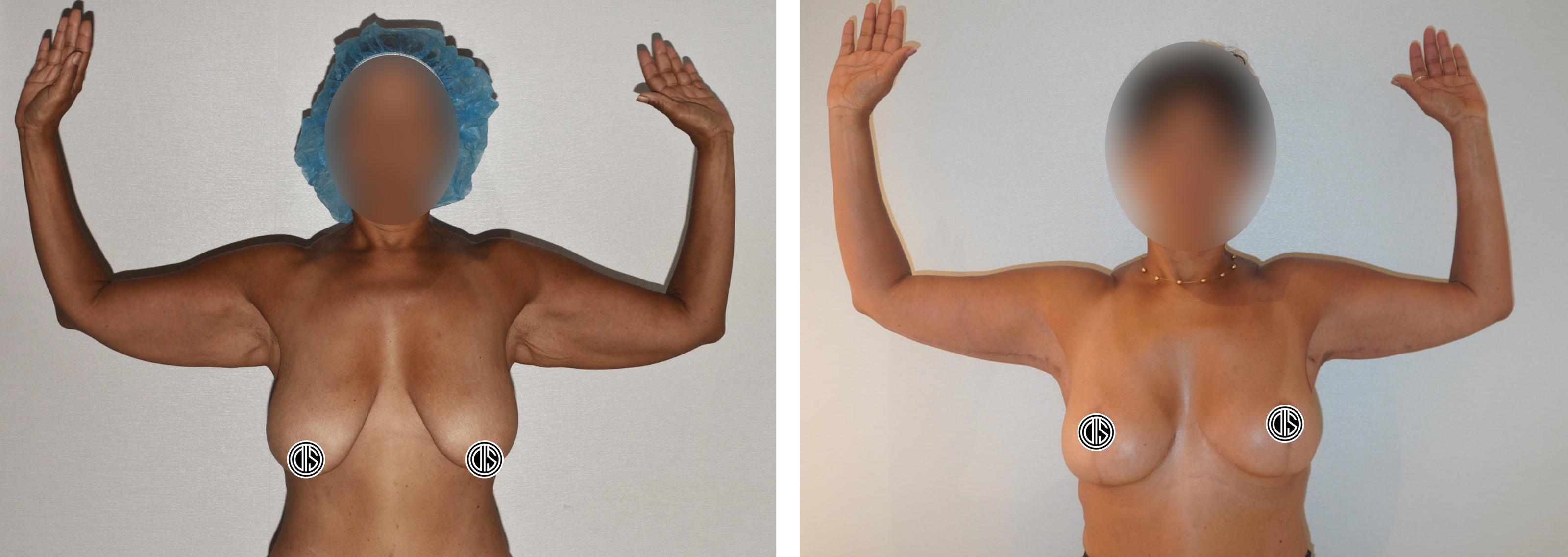
This patient lost more than 100 pounds with a GLP-1 medication. An extended arm lift addressed excess upper-arm and underarm skin, while breast reduction and lift with auto-augmentation reshaped her breasts using her own tissue without implants.
View Patient 7 details & photos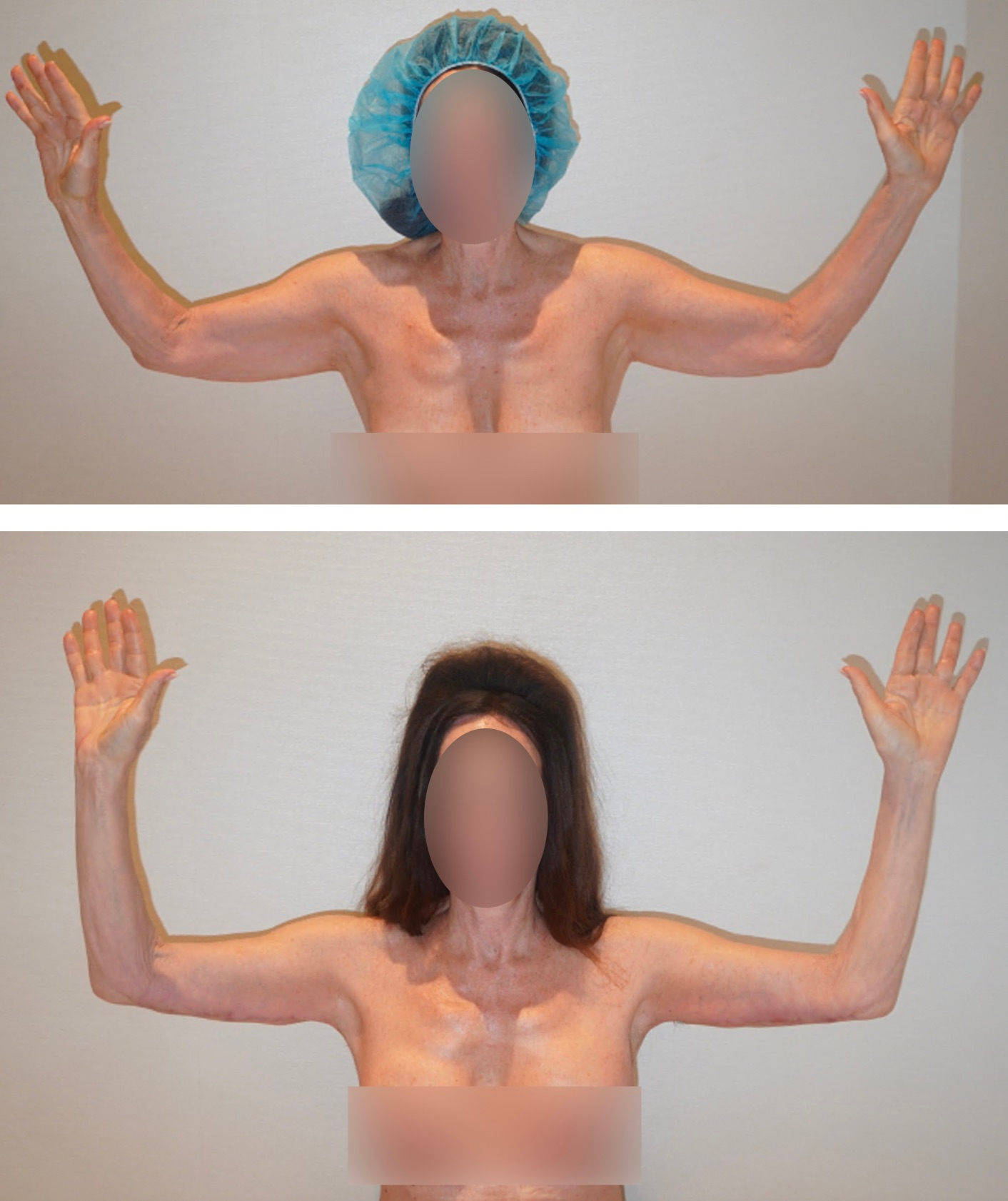
Arm Lift (Brachioplasty)
Patient 2
Before and after Arm Lift
- Treatment performed
- Arm lift (brachioplasty)
Individual results may vary.
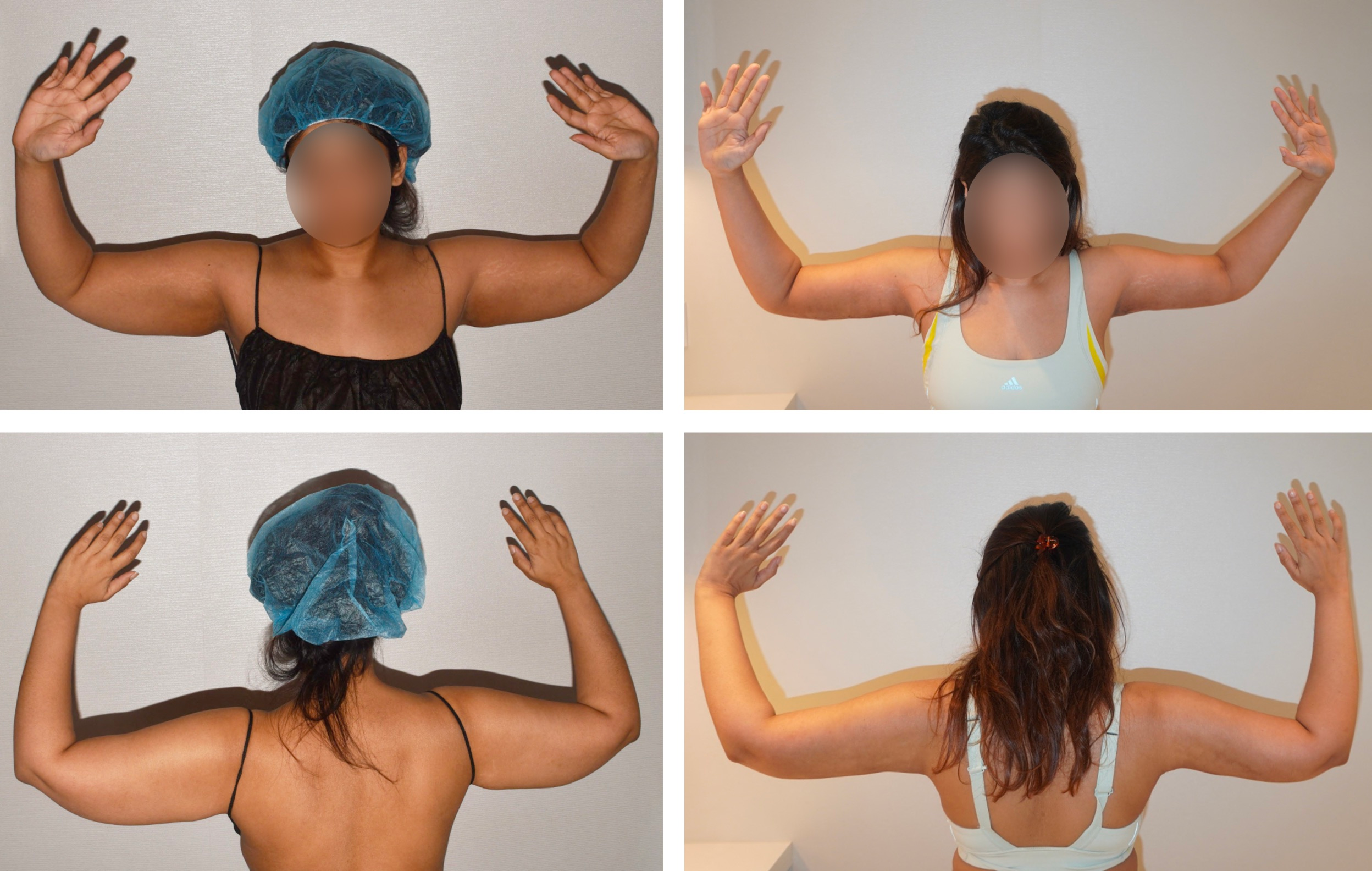
Arm Lift (Brachioplasty)
Patient 3
Before and after Arm Lift
- Treatment performed
- Arm lift (brachioplasty)
Individual results may vary.
Individual results may vary.
What an arm lift is, and how Dr. Smith thinks about arm contour.
An arm lift, or brachioplasty, removes excess skin from the upper arm through an incision on the inner surface of the arm. It is the last step in a sequence rather than the first, and the only option on this page that treats skin by cutting it out.
Dr. Smith takes what he calls a problem based approach. Three tissues determine the shape of an arm: muscle, fat, and skin. Naming the one responsible is the decision.
The ladder
The order he describes is explicit and sequential. Build the muscle foundation first. Uncover it by removing the fat over it. Then make sure the skin is not in the way to hide the result. A patient may need one rung, two, or all three. Each of the three goals patients arrive with points at a tissue: definition is a muscle and fat question, smaller circumference a fat question, excess hanging tissue a skin question. Only the third leads to an arm lift.
Severity of the skin excess is the single pivot between a minimally invasive approach and an excisional one. Mild to moderate looseness can be treated with radiofrequency skin tightening through the same small incisions used for liposuction. Severe looseness cannot, and that is where brachioplasty enters. Dr. Smith names that judgment itself as the skill.
The four rungs.
1. Muscle: Emsculpt
Who it suits. People who want better definition and have already worked at it. The classic way to improve arm muscle definition is the gym, and Dr. Smith says so before offering anything else. Emsculpt is for patients who have maxed out there, or who lack the time for it.
What it does. Highly focused electromagnetic energy causes supramaximal contractions of the biceps or triceps, stronger than a patient could achieve alone, roughly 20,000 of them in about 30 minutes. Non-invasive, no incision.
What it cannot do. It removes no fat and treats no loose skin. Muscle built under a layer of fat produces no visible definition, which is why this rung does not stand alone.
2. Fat: arm liposuction alone
Who it suits. Patients whose arms are bulkier than they want, or whose muscle is hidden under fat, with skin tight enough to shrink back on its own. See arm liposuction in NYC for the procedure in full.
What it does. Targeted liposuction reduces the circumference of the arm and exposes the underlying muscle, which is what produces an athletic looking arm. Dr. Smith calls it powerful and very easy to go through, often done under local anesthesia in about 45 minutes.
What it cannot do. It does not tighten skin. Where there is meaningful laxity, removing fat leaves the skin with less to fill it and the arm can look worse rather than better. Skin quality caps how much fat can safely come out.
3. Skin, mild to moderate: liposuction with radiofrequency tightening
Who it suits. Patients with mild to moderate skin excess of the arms. This is Dr. Smith's preferred approach for that group, usually performed at the same sitting as the liposuction.
What it does. The BodyTite device is bipolar radiofrequency. One prong passes under the skin, one stays above it, and energy passes between the two. The tissue is heated in a controlled way to the temperatures known to cause skin contraction, which also builds collagen and elastin, shrink wrapping the skin onto the contour already achieved. Temperature is sensed at both poles, which keeps a heat based treatment inside a safe range.
What it cannot do. It does not remove skin. For severe laxity it is not a good approach, and a patient whose laxity is too extreme for the device will not get a satisfying result. Dr. Smith is direct that these devices deliver a fraction of what excision delivers, and brachioplasty is the benchmark he measures them against.
4. Skin, severe: excisional brachioplasty
Who it suits. People with severe skin excess, and only those people. It is the answer when there is too much skin for radiofrequency energy to adequately address.
What it does. It removes skin directly, through an incision on the inner arm running from the armpit toward the elbow. Where the excess sits only in the upper third, a smaller version hidden in the armpit may be possible.
What it cannot do. It cannot be done without a permanent scar. Dr. Smith calls this a pretty major procedure and does not soften it. The trade is set out below.
Incisions, and where they sit.
Liposuction, and liposuction with radiofrequency
Arm liposuction uses a couple of extremely well hidden incisions about two to three millimeters long, placed in the folds behind the arm where it meets the shoulder, where nobody is really going to see them. Tumescent numbing fluid goes in through those incisions, and a cannula follows through the same openings.
Radiofrequency skin tightening adds no new incision. The BodyTite probes go through the incisions already made for the liposuction, which is why the two are usually combined.
Mini brachioplasty
A mini brachioplasty is for patients with the majority of their skin excess in the upper third of the arm. Instead of a long incision from the inside of the shoulder to the elbow, a much smaller one is hidden in the armpit. More in Dr. Smith's article on minimal incision brachioplasty.
Full brachioplasty
The far and away most common kind of arm lift places an incision on the inside surface of the arm, running essentially from the armpit to the elbow, and that is what allows the skin to be removed. Where the excess runs the length of the arm, the incision runs with it. Distribution of the excess, not preference, decides between the armpit incision and the full one.
The scar, stated plainly.
A full arm lift leaves a real scar, it is fairly long, and it is permanent. Dr. Smith's own words: this is a pretty major procedure and it does leave a real scar behind, which usually does fade over time, but a patient will always have some scar present.
It runs along the inner arm from the armpit toward the elbow. Unlike a tummy tuck scar it cannot be hidden under clothing worn in warm weather. It shows in a sleeveless top and with the arm raised.
He frames the operation as a trade, and puts the condition on the patient rather than on the result. Brachioplasty is for people who really have severe skin excess and are willing to trade having that scar for an improvement in their skin excess. A patient unwilling to make that trade is not a candidate, however much loose skin they have. That is why the lower rungs are worked through first.
The same honesty runs the other way. A patient with severe laxity who picks a device to avoid a scar is choosing a fraction of the result, not a different route to the same one.
Who each approach suits.
- Emsculpt. Goal is definition, fat and skin already where the patient wants them, gym progress plateaued.
- Liposuction alone. Extra arm fat with good skin elasticity, where the skin will contract to the new shape on its own.
- Liposuction with radiofrequency tightening. The same fat problem plus mild to moderate skin laxity, treated at one sitting.
- Mini brachioplasty. Skin excess concentrated in the upper third of the arm, near the armpit.
- Full brachioplasty. Severe skin excess along the arm, in a patient who accepts the scar.
Skin elasticity moves a patient from one rung to the next and is assessed by examination. Age, smoking and genetics all affect how skin responds to having volume removed from underneath it, and that response can be predicted to a reasonable degree at consultation. Good general health is required for any elective aesthetic procedure. Separately, the bulge of fat under the arm that spills over a bra responds well to liposuction, while loose skin in that same spot is a different problem, treated with AccuTite.
What the practice requires before surgery
- No nicotine in any form for four weeks before surgery and four weeks after it. That includes cigarettes, vaping, pouches, patches and gum. The practice tests for nicotine. It matters particularly here, because an arm lift depends on a long inner arm incision healing well and nicotine constricts the blood supply that healing runs on.
- Review all medicines and supplements at consultation, including prescriptions and over-the-counter products. The practice’s 10-day preoperative pause for substances that act as blood thinners applies only when the surgical team and, for prescribed medicines, the prescribing clinician agree it is appropriate. Do not stop a prescribed medicine on your own.
- Medical clearance and laboratory work for any case done under anesthesia, and laboratory work for cases done under local anesthesia. Patients over 40 having anesthesia also have an EKG.
- Weight stable for three months before the operation, since the amount of skin to be removed is measured against the arm as it is on the day of surgery.
Recovery after an arm lift.
Arm liposuction alone
The procedure does not usually take more than 45 minutes and the patient goes home right afterward. A compression garment is worn for four weeks, which is the practice's rule after any liposuction. Dr. Smith's example is a Friday procedure: back at work Monday in almost all cases, back at the gym by Wednesday for most people, with the garment still on.
Arm liposuction with radiofrequency tightening
Recovery is very similar. The compression garment is worn for four weeks, the same as for liposuction alone, because four weeks is the rule whether or not radiofrequency is added. The tightening result is not immediate: a small improvement shows early, and the final result takes several months as the controlled injury heals and the skin contracts.
Emsculpt
No downtime. The protocol is four sessions over two weeks, each about 30 minutes. Paired with liposuction, Dr. Smith describes starting it about two weeks afterward, where it both builds muscle and helps work the swelling out.
Brachioplasty
An arm lift is performed under general anesthesia or IV sedation, depending on the case, and which one is used is settled with the board-certified anesthesiologist before the date. Patients go home the same day. No drains are used. The sutures are usually internal and are not removed.
Most patients who work remotely return to work at about one week, and most patients who work in an office return at about two weeks. A compression garment is worn for four weeks.
Expect the arms to be swollen to larger than they were before surgery for the first one to two weeks. That is the normal course rather than a sign that something has gone wrong. There is significant improvement in appearance by one month, and most of the result is present by three months.
Activity is released in stages, and the arm is the last thing released. Light core and lower body exercise resumes at two weeks. Light upper body exercise resumes at four weeks, because that is the repair being protected. From there activity ramps up to no restrictions at six weeks.
A mini brachioplasty follows the same recovery pattern on a smaller operation. Where the timeline differs for a particular patient it is given at consultation and in the written instructions provided before surgery.
Follow-up visits, and who provides post-operative care
Patients are seen the next morning, then at one week, two weeks, one month, three months, six months and one year. That schedule is the minimum, and patients may come in as often as they want on top of it.
Dr. Smith leads all post-operative care himself. He and the practice's physician assistant see post-operative patients together, and he is present for every major visit; some minor visits may be with the physician assistant alone. The arrangement gives patients continuity from the surgeon who performed the operation, with enough capacity in the schedule that a patient who wants to be seen is seen, rather than being rationed to a fixed number of appointments.
Risks.
Every rung carries risk, and the risk rises with invasiveness. Dr. Smith's position is that these procedures are safe when done the right way by an experienced provider, and that there are risks a patient should discuss specifically beforehand.
For radiofrequency skin tightening he names infection, bleeding problems, and damage to nerves in the area. He is candid that the technique is demanding: both poles have to be held at fairly precise temperatures for the right amount of time, which he calls finicky and says requires real expertise to master. Outcome depends on the skill of the person performing it and on patient selection.
Excisional brachioplasty carries the risks of any surgical procedure: bleeding, infection, poor scar formation, changes in skin sensation, wound healing problems, asymmetry, anesthesia risk, and the possibility of further surgery. The permanent scar is not a complication. It is an expected outcome, discussed above.
Procedures are performed in Dr. Smith's accredited outpatient surgical facility inside his Manhattan office at 111 East 57th Street, with board-certified anesthesiologists only. The facility is accredited by QUAD A. Dr. Smith is board-certified by the American Board of Plastic Surgery.
What drives the cost of an arm lift.
Invasiveness is the largest single driver: the further up the ladder a plan sits, the more it costs. A device treatment, liposuction under local anesthesia, that liposuction with radiofrequency tightening added, and an excisional arm lift are four levels of cost, in that order.
The other drivers are the anesthesia and who administers it, the facility, the length of the procedure, how many areas are treated at once, the number of sessions a device protocol calls for, and the surgeon's qualifications and experience. Combining rungs in one sitting is more efficient than staging them, because anesthesia and facility time are shared, but whether to combine is a clinical question first.
The quote, the deposit and the revision policy
Every quote is itemized into a surgeon's fee, a facility fee and an anesthesia fee, so that each component is visible rather than bundled into one number. All post-operative visits are included in the quote. Other items are not. A quote is valid for 30 days, and a 10 percent deposit is taken at booking.
For one year after surgery there is no surgeon's fee on a revision. The patient remains responsible for the anesthesia and facility fees if a revision is performed.
Consultations are $500, applied toward any procedure booked, and the fee is not waived. The practice offers financing through CareCredit and Alphaeon Credit. Dr. Smith is out of network with all insurance plans; the practice helps patients use out-of-network benefits toward care.
Your questions about arm lift surgery.
Do I need an arm lift, or will liposuction be enough?
It depends on how much loose skin you have. If the problem is extra fat and your skin is elastic enough to contract onto the smaller arm, liposuction alone is enough. If you have mild to moderate skin laxity, radiofrequency tightening can be added at the same sitting through the same incisions. An arm lift is for severe skin excess, where there is too much skin for a device to address. The determination is made by examination.
Where will my arm lift scar be, and how bad is it?
On the inner surface of the arm, running essentially from the armpit to the elbow. Dr. Smith is blunt about it: it is a real scar, it is fairly long, it usually fades over time, and you will always have some scar present. It shows in a sleeveless top and with the arm raised. The operation is for people with severe skin excess who are willing to trade that scar for the improvement.
Is there an arm lift with a shorter scar?
Yes, for the right anatomy. A mini brachioplasty uses a much smaller incision hidden in the armpit rather than one running from the shoulder to the elbow. It is an option for people whose skin excess is confined to the upper third of the arm, near the armpit. Where the excess runs the length of the arm, the longer incision is what the anatomy requires.
Can radiofrequency skin tightening replace an arm lift?
No. Radiofrequency tightening delivers a fraction of what an excisional operation delivers, and brachioplasty is the benchmark it is measured against for the arm. For mild to moderate laxity it works well. For severe laxity it is not a good approach, and a patient whose skin laxity is too extreme for the device will not get a satisfying result.
How big are the liposuction incisions on the arm?
About two to three millimeters, and there are only a couple of them. They are usually placed in the folds behind the arm where the arm meets the shoulder, where they are very well hidden. The radiofrequency probes go through those same incisions, so adding skin tightening does not add an incision.
Do I have to go to sleep for arm liposuction?
No. Arm liposuction is often performed under local anesthesia, so you do not need to go to sleep for it. You can choose to be asleep if you prefer, but it is not required for this kind of procedure. You go home right afterward.
How long do I wear the compression garment?
Four weeks. That is the rule after any liposuction, whether or not radiofrequency skin tightening is added, and it is also four weeks after an arm lift. Written instructions cover when the garment comes off to shower and how it is washed.
When can I go back to work after arm liposuction?
Very quickly. Dr. Smith's own example is a Friday procedure with a return to work on Monday in almost all cases and back at the gym by Wednesday for most people. That guidance is for arm liposuction, not for an arm lift.
How long does arm lift surgery take?
Operating time depends on whether you need a limited or full arm lift and whether liposuction is part of the plan. Arm-liposuction timings should not be used as an estimate for an excisional arm lift. Ask for an estimate for your specific operation at consultation, along with the total time to allow at the surgical facility.
How long is the recovery after an arm lift?
About a week before remote work and about two weeks before office work, with no restrictions at six weeks. The operation is done under general anesthesia or IV sedation depending on the case, and you go home the same day. There are no drains, and the sutures are usually internal and are not removed. Expect your arms to be swollen to larger than they were before surgery for the first one to two weeks. A compression garment is worn for four weeks. Light core and lower body exercise resumes at two weeks and light upper body exercise at four weeks. There is significant improvement in appearance by one month, and most of the result is there by three months. A mini brachioplasty follows the same pattern on a smaller operation.
Will Emsculpt tighten loose arm skin?
No. Emsculpt builds muscle. It uses focused electromagnetic energy to produce roughly 20,000 supramaximal contractions of the biceps or triceps in about 30 minutes, over four sessions across two weeks. It does not remove fat and it does not treat skin. It is the foundation the other steps uncover.
Can more than one of these be done at the same time?
Yes, and combining is the norm rather than the exception. Radiofrequency tightening is usually performed at the same sitting as liposuction through the same incisions. Emsculpt is non-invasive and is described as often starting about two weeks after liposuction, where it also helps work out swelling and speed recovery.
What about the fat that spills over my bra under the arm?
That bulge responds very effectively to liposuction. If the problem in that same spot is loose skin rather than fat, the treatment is different: AccuTite, a much smaller version of the same radiofrequency technology, is used for tightening skin under the armpits. Two tissues in one place, two different treatments.