

What stomach liposuction does, and what it cannot do.
Stomach liposuction removes superficial fat from the abdomen to change its shape. It is a shape change procedure, not a weight loss procedure, and in the most common case Dr. Smith sees it is the whole answer: in a patient with strong abdominal muscles and good skin elasticity, removing the fat drops the volume and the skin shrink wraps to the new, flatter form.
Superficial fat and visceral fat
Only one of the two kinds of abdominal fat can be suctioned. Superficial fat sits above the abdominal wall, between the wall and the skin, and that is the layer a cannula reaches. Visceral fat sits below the abdominal wall, around the organs, and liposuction never goes below the wall. Dr. Smith states the limit without hedging: there is no surgical way to address visceral fat, so it is handled with diet and exercise.
The distinction decides who benefits. A soft abdomen that pinches thickly is mostly superficial fat and is what liposuction is for. A firm, round abdomen that does not pinch is mostly visceral, and suctioning it would change very little. Which one a patient has is settled by examination at consultation. Liposuction also does not repair a rectus diastasis or tighten genuinely lax skin, limits covered below.
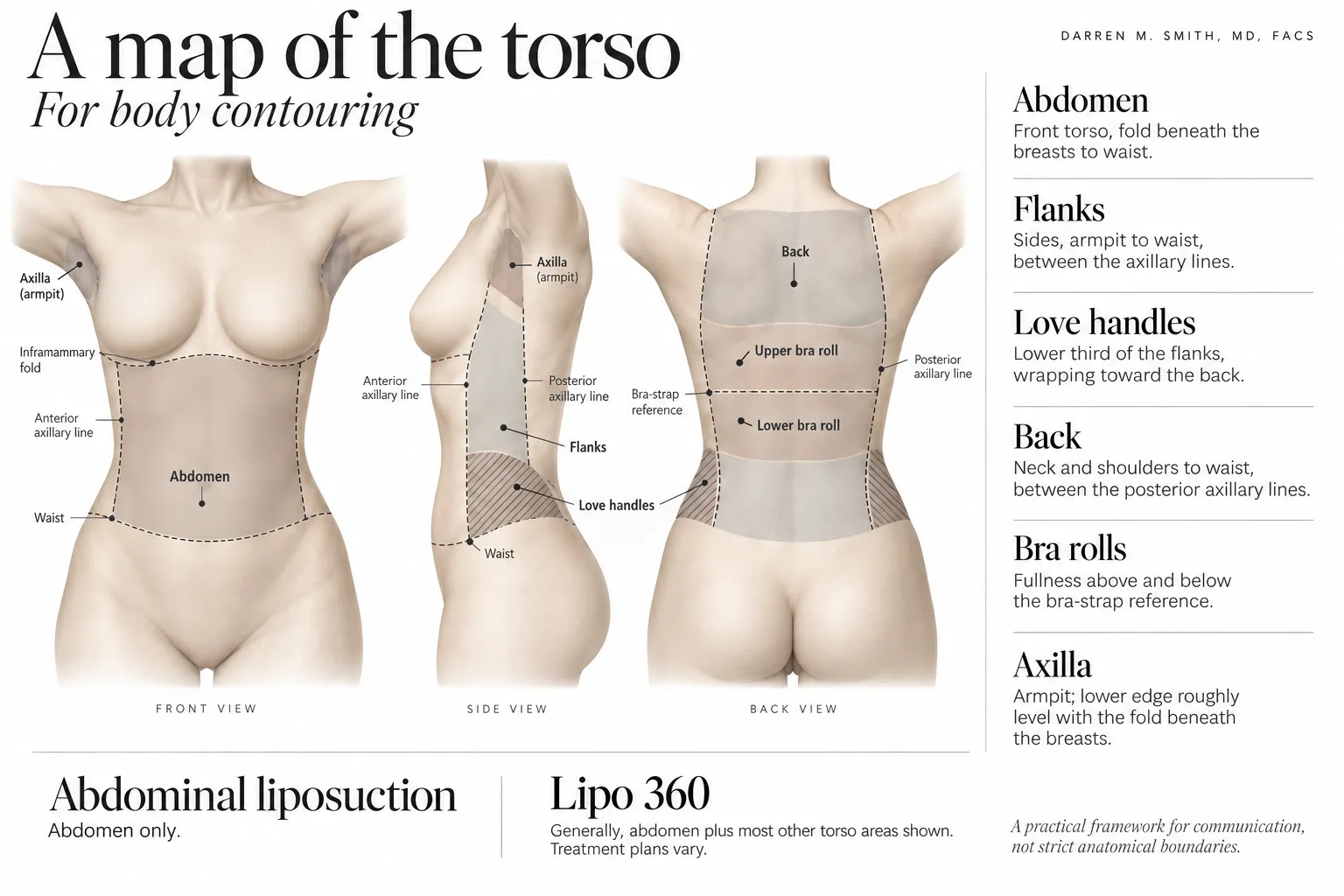
A map of the torso for body contouring
Abdominal (stomach) liposuction treats the abdomen only: the front of the torso. The definitions below distinguish it from the surrounding areas.
When we plan body contouring, it helps for you and me to use the same words for the same places. The definitions below are not strict anatomical boundaries. They are a practical framework so we can communicate clearly about what will be treated.
Abdomen. The front of the torso, from the fold beneath the breasts (the inframammary fold) down to the waist. On each side, it ends at the anterior axillary line: an imaginary vertical line that drops from the front edge of the armpit.
Flanks. The sides of the torso, from the armpit down to the waist. The front border is the anterior axillary line described above; the back border is the posterior axillary line, which drops from the rear edge of the armpit.
Love handles. The area of fullness in roughly the lower third of the flanks that can often be pinched and that wraps around toward the back.
Back. The rear surface of the torso. It runs from the neck and shoulders down to the waist, and from one posterior axillary line to the other.
Upper and lower bra rolls. Two areas of fullness on the back: the upper bra roll sits above where a bra strap would lie, and the lower bra roll sits below it.
Axilla (armpit). The recessed area under the shoulder. Its lower edge sits at about the same height as the inframammary fold.
Abdominal liposuction vs. Lipo 360
Lipo 360 is a looser term, but it generally means abdominal liposuction plus treatment of most of the other areas of the torso described above. Dr. Smith sets out in writing exactly which areas your individual plan covers.
For fullness concentrated in the lower flanks, learn about love-handle liposuction.
BEFORE & AFTER PHOTOGRAPHS
Abdomen, Waist, and Lipo 360 gallery
Explore photographs from our abdomen, waist, and lipo 360 gallery. Individual results vary.
Abdomen and waist contouring — Case 21
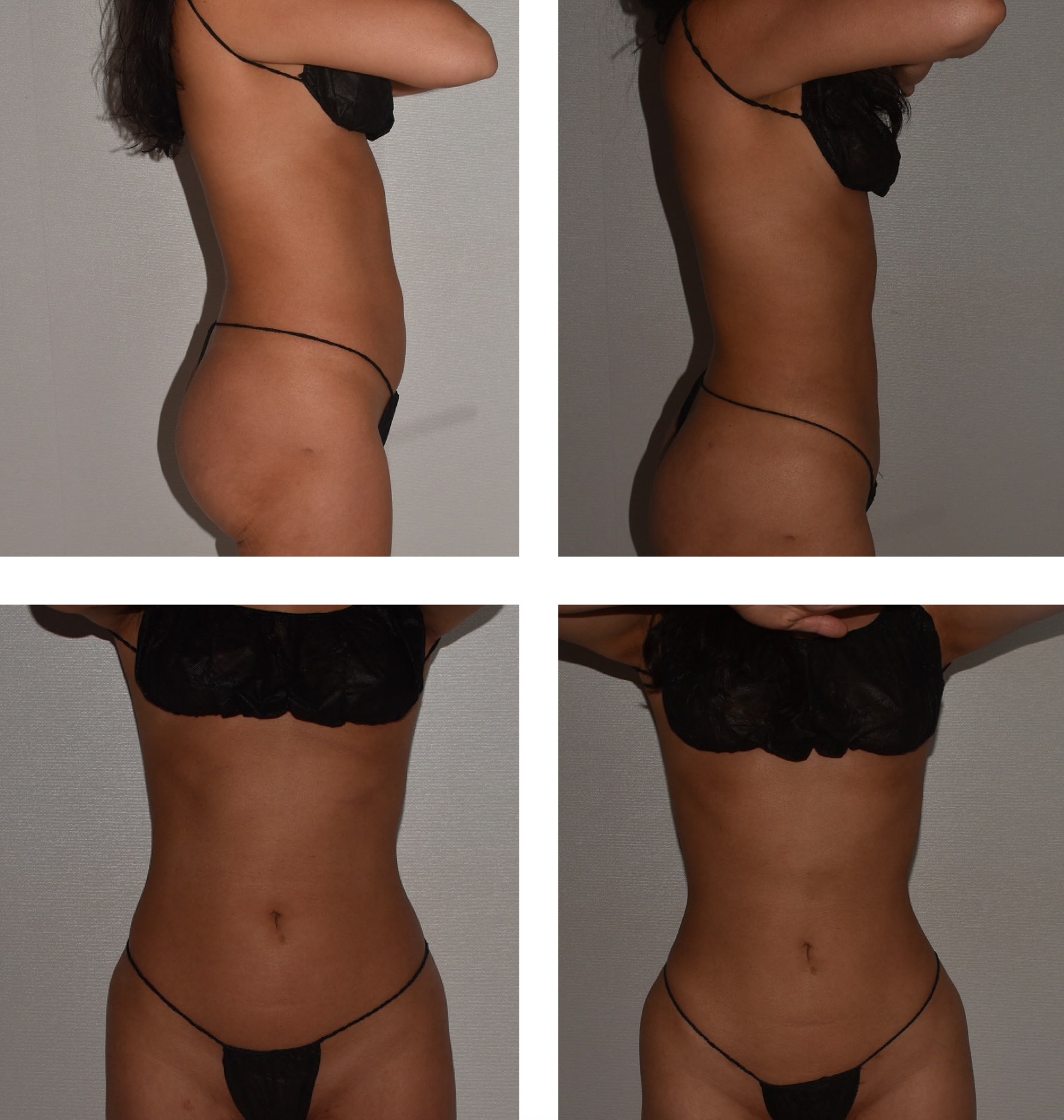
Liposuction for localized lower-abdominal fullness
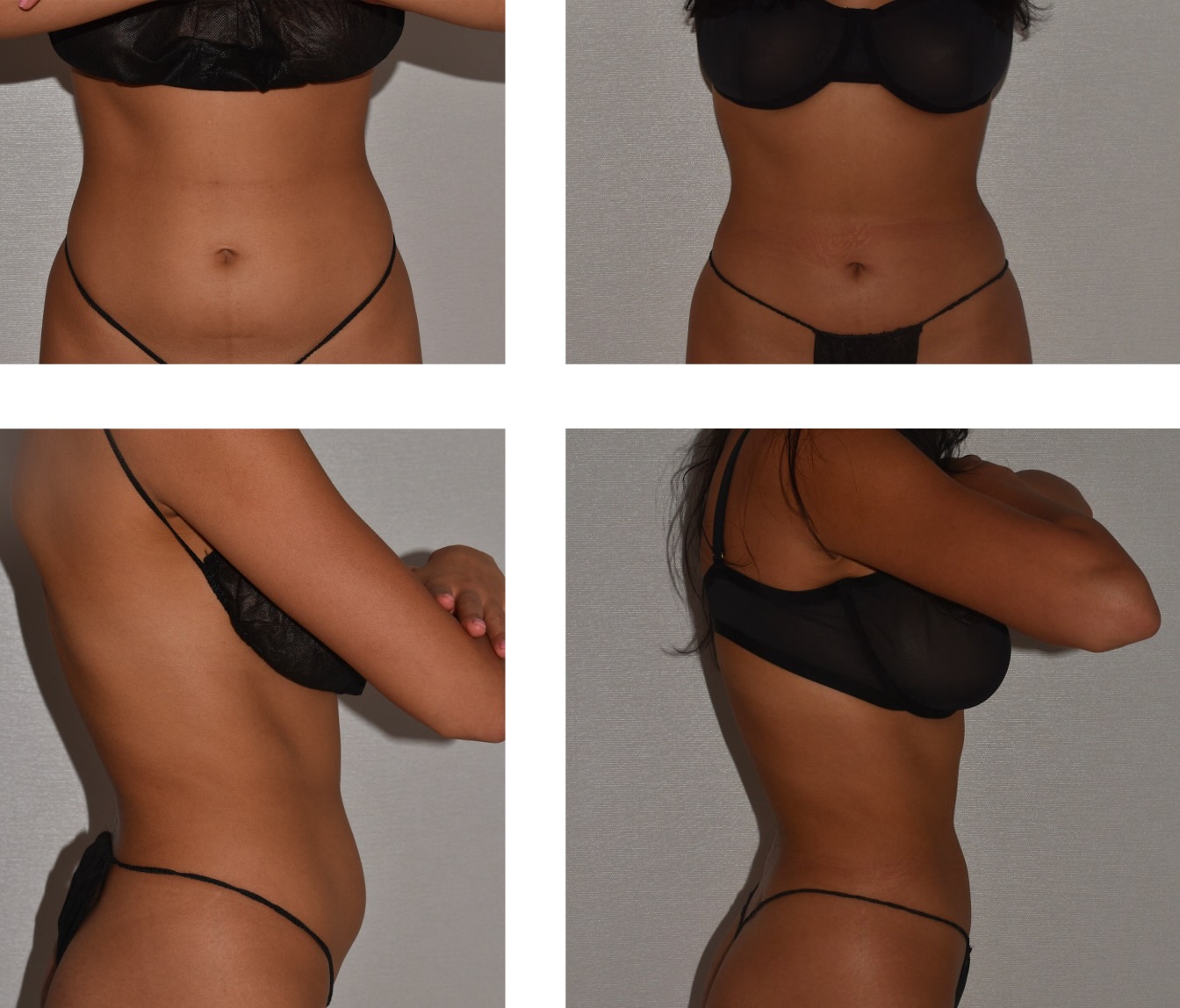
Discuss your goals and the treatment options for your anatomy with Dr. Darren M. Smith at a consultation in New York City.
Abdominal liposuction awake, under local anesthesia.
Smaller, limited abdominal liposuction cases can be performed awake under local anesthesia, meaning the patient is numb but awake and breathing on their own, with no breathing tube and no sedation. Larger cases are not done this way. They are performed under twilight sedation or general anesthesia, given by a board-certified anesthesiologist. Which category a particular abdomen falls into is decided by examination at consultation, so no patient should assume in advance that their case will be a local one.
Where local anesthesia does apply, the option is a popular one for practical reasons: the recovery is easy and there is minimal discomfort with the way the procedure is performed. Twilight sedation and general anesthesia remain available to any patient who would rather not be awake, including patients whose case would otherwise qualify for local.
Liposuction of multiple areas around the torso at one sitting is a different operation with a different rule: Dr. Smith will not do that one under local alone, and it is always performed with twilight or general anesthesia.
Who is in the room
An awake local case is staffed by Dr. Smith with a nurse and a technician present throughout. It is performed in his accredited outpatient surgical facility inside his Manhattan office, the same facility used for sedated and general anesthesia cases, where a board-certified anesthesiologist joins the team. The facility is accredited by QUAD A.
How a smaller case runs under local
Patients walk into the office on the day of the procedure. Markings come first, drawn with the patient standing, and they become the landmarks used once the patient is lying down, so the contour comes out as planned rather than as it looks flat on a table. In the operating room the abdomen is painted with Betadine or a similar solution.
A series of very small access incisions is then made, three to four millimeters each, smaller than a pencil eraser in most cases, placed in well hidden regions: the waist crease, or the belly button itself.
Tumescent solution is instilled through those incisions. Its composition is plain: a base fluid of lactated Ringer's, with epinephrine added to constrict blood vessels and lidocaine added as the numbing medication. The epinephrine is why an awake liposuction bleeds very little, and the lidocaine is why it does not hurt.
Then everyone waits. The solution is left to work for 10 to 15 minutes to make sure the patient is genuinely numb before anything else happens. That pause is what makes the awake case comfortable.
A cannula, a long thin instrument connected to suction, is passed through each incision and used to carefully remove fat and shape the contour. When the contour looks right it is checked a second way: Dr. Smith feels the abdomen and pinches it in various places to confirm the result is even. Unevenness is easier to find by feel than by eye, and far easier to correct before closing than after healing. The incisions are closed with a couple of sutures, a compression garment goes on, and the patient goes to the recovery room.
What the patient experiences
The tumescent solution numbs the treatment area before suction starts. Patients may feel pressure and movement, but sensations and discomfort vary. Tell the surgical team if you feel pain during treatment. Discomfort can change as the numbing wears off. Read about recovery.
Who stomach liposuction suits.
The best candidate is in generally good health, the baseline for any elective aesthetic procedure, and has excess superficial fat with good skin elasticity and a sound abdominal wall. In that patient, liposuction alone produces an excellent result.
Loose skin does not automatically rule you out
Most surgeons list loose skin as a contraindication to abdominal liposuction. Dr. Smith treats it as a conversation about which result the patient is buying. If the skin has poor elasticity and fat is removed, the skin will not shrink back to a good shape: the abdomen gets smaller and the surface can be left wavy, rippled or hanging. A patient who wants a smooth uncovered abdomen will not get it that way and should be considering skin excision.
But some patients with loose skin do not care much about how it looks. What they want is a smaller waistline and to look considerably better in clothes, and abdominal liposuction delivers exactly that even when the skin is lax. Dr. Smith calls that a perfectly reasonable thing to want, on the condition that the patient knows precisely what result they will have before agreeing to it. What he refuses is not operating on loose skin; it is letting a patient expect a result the operation cannot produce.
A middle option for mild to moderate laxity
Where laxity is mild to moderate, radiofrequency skin tightening can be added instead of trading up to an excisional operation. BodyTite is delivered through the same three to four millimeter incisions already made for the liposuction, so it adds no new scars, and it handles mild to moderate loose skin without a whole tummy tuck. It does not substitute for excision when laxity is severe.
What the practice requires before surgery
- No nicotine in any form for four weeks before surgery and four weeks after it. That includes cigarettes, vaping, pouches, patches and gum. The practice tests for nicotine.
- The practice’s 10-day preoperative pause for medicines or supplements that act as blood thinners applies only when the surgical team and, for prescribed medicines, the prescribing clinician agree it is appropriate. Do not stop a prescribed medicine on your own. The list is reviewed at consultation, because it includes common supplements as well as prescriptions.
- Medical clearance and laboratory work for any case done under anesthesia, and laboratory work for cases done under local anesthesia. Patients over 40 having anesthesia also have an EKG.
- Weight stable for three months before the operation, so that the plan is drawn on an abdomen that is not still changing.
When liposuction is the wrong operation
- The fat is mostly visceral.
- A rectus diastasis is producing the bulge, which would remain.
- The skin is significantly lax and the goal is a smooth uncovered abdomen.
- The goal is weight loss rather than a change in shape.
Liposuction or a tummy tuck?
What is causing the bulge decides the operation, not how much a patient wants to avoid surgery. Dr. Smith answers this anatomically, using three layers: skin outside, fat beneath it, abdominal wall beneath that. Whichever layer is producing the shape the patient dislikes has to be the layer treated.
If fat is the only problem and the skin and abdominal wall are sound, liposuction alone is enough and a tummy tuck is more operation than the anatomy calls for. If the skin is significantly lax or the rectus muscles have separated, liposuction alone will not produce a pleasing contour and can make the abdomen look worse. There, an abdominoplasty, which excises skin and sews the separated muscles back together, remains the gold standard, though mild to moderate problems in those layers can now be improved without excising skin. The full comparison, the muscle repair and the scar are on the tummy tuck page.
Recovery after abdominal liposuction.
Most patients with a standard desk job are back at work 48 hours after abdominal liposuction, wearing the compression garment under their clothes. Dr. Smith flags the schedule as his own protocol, which varies from practice to practice; written instructions are given beforehand.
The compression garment
The compression garment is worn for four weeks after abdominal liposuction. That is the rule for abdominal liposuction in the practice, and it does not change when radiofrequency skin tightening is added through the same incisions. The garment controls swelling and holds the skin down against the tissue beneath it while the contour settles, which is why the period is measured in weeks rather than days. Written instructions cover when it comes off to shower and how it is washed.
The first two days
Discomfort varies and can increase as the numbing medication wears off. Many patients describe a cramping soreness, like the feeling after a hard abdominal workout. Severe or worsening pain needs prompt assessment by your surgical team; do not assume it is part of routine recovery.
A small amount of watery, blood-tinged drainage can occur during the first day or two. Contact your surgical team promptly if drainage increases, becomes foul-smelling, or occurs with fever, worsening pain or redness. Follow your individual dressing instructions.
For an urgent postoperative concern after office hours, call 212-633-0627 and select option 2 to reach Dr. Smith directly. If you have sudden difficulty breathing, call 911 or your local emergency number.
Weeks and months
The result does not show up early, and patients are told so in advance. For the first week or two the abdomen can look as though almost nothing was done: a significant volume of fat came out, but a significant volume of numbing fluid went in, and with the swelling the two roughly cancel out. After about two weeks a really nice change appears. Most bruising is gone at 10 to 14 days, and the final result takes a good several months, usually about three.
For muscle definition on top of the contour change, Emsculpt Neo can be added as a course of four to six sessions, started about two weeks after the liposuction. Dr. Smith has also observed that it seems to speed the resolution of swelling and some of the discomfort of recovery, an observation from his practice rather than published data.
Follow-up visits, and who provides post-operative care
Patients are seen the next morning, then at one week, two weeks, one month, three months, six months and one year. That schedule is the minimum, and patients may come in as often as they want on top of it.
Dr. Smith leads all post-operative care himself. He and the practice's physician assistant see post-operative patients together, and he is present for every major visit; some minor visits may be with the physician assistant alone. The arrangement is what allows both things patients want at once: continuity from the surgeon who performed the operation, and enough capacity in the schedule that a patient who wants to be seen is seen, rather than being rationed to a fixed number of appointments.
Safety, risks and limits.
Liposuction is a safe operation performed properly, and most of what determines that is the setting rather than the technique. It carries risks common to surgery: bleeding, infection, contour irregularity, asymmetry, changes in skin sensation, fluid collection, poor scarring at the access incisions and the possibility of a revision. A smaller case done under local alone avoids the risks that come with sedation and general anesthesia, and sedated or sleeping patients are cared for by a board-certified anesthesiologist.
The limits matter as much as the risks: no effect on visceral fat, no repair of a diastasis, no tightening of significantly lax skin, no weight loss.
Choosing where to have it done
Liposuction is easy to cut corners on, because it needs little specialty equipment, and Dr. Smith says so directly. Corners get cut on equipment, on the number and experience of the people in the room, and on the overall quality of the experience. He tells patients to ask a prospective surgeon: Is the surgeon board certified? Who else will be in the room, will a nurse be present, will the patient be monitored, will sterile equipment and drapes be used? What complications have they had, and how were they handled? Dr. Smith is board-certified by the American Board of Plastic Surgery, operates in his own accredited outpatient surgical facility, accredited by QUAD A and works only with board-certified anesthesiologists. Power-assisted liposuction is among the techniques performed in the practice; which instrumentation suits a given case is decided at consultation.
What drives the cost of stomach liposuction.
There is no single price, because the operation is scaled to the anatomy and to how it is performed. What moves it:
- How much of the abdomen is treated and how much fat is removed.
- The anesthesia chosen. A smaller case done awake under local alone carries no anesthesiologist's fee; twilight and general anesthesia do, and larger cases require one of the two.
- Time in the accredited operating room and the facility fee.
- Whether BodyTite skin tightening is added through the same incisions.
- Whether Emsculpt is added afterward.
- Whether other areas or procedures are treated at the same sitting. Combining is usually more economical than staging, because the team and room are set up once.
The quote, the deposit and the revision policy
Every quote is itemized into a surgeon's fee, a facility fee and an anesthesia fee, so that each component is visible rather than bundled into one number. All post-operative visits are included in the quote. Other items are not. A quote is valid for 30 days, and a 10 percent deposit is taken at booking.
For one year after surgery there is no surgeon's fee on a revision. The patient remains responsible for the anesthesia and facility fees if a revision is performed.
Consultations are $500, applied toward any procedure booked, and the fee is not waived. Financing is available through CareCredit and Alphaeon Credit. Dr. Smith is out of network with all insurance plans; the practice helps patients use out-of-network benefits toward care.
Your questions about stomach liposuction.
Can I be awake for abdominal liposuction?
Sometimes. Smaller, limited abdominal cases can be performed awake under local anesthesia, which means you are numb but awake and breathing on your own. Larger cases are not done that way and are performed under twilight sedation or general anesthesia with a board-certified anesthesiologist. Whether your case qualifies is decided by examination at consultation. For an awake local case, Dr. Smith is joined in the room by a nurse and a technician.
Does awake liposuction hurt?
The tumescent solution instilled at the start contains lidocaine and is left in place for 10 to 15 minutes before any suction begins to numb the treatment area. Patients may feel pressure and movement, but sensations and discomfort vary. Tell the surgical team if you feel pain during treatment. Discomfort can change as the numbing wears off.
What is in the tumescent solution?
A base fluid called lactated Ringer's, with two medications added: epinephrine, which constricts blood vessels and greatly reduces bleeding, and lidocaine, which provides the numbing.
Where are the incisions and how big are they?
They are three to four millimeters each, smaller than a pencil eraser in most cases, placed in well hidden regions such as the waist crease or inside the belly button. Each is closed with a couple of sutures.
Will liposuction get rid of the fat around my organs?
No. Liposuction removes superficial fat, which lies above the abdominal wall. Visceral fat lies below the abdominal wall around the organs, and liposuction does not go below the abdominal wall. There is no surgical way to address visceral fat; it is handled with diet and exercise.
Can I have abdominal liposuction if I have loose skin?
Often yes, provided you know what result to expect. If you want a smooth uncovered abdomen, loose skin means liposuction alone can leave you with rippling or hanging skin, and skin excision is the better answer. If what you want is a smaller waistline and to look much better in clothes, liposuction can do that even with lax skin, and Dr. Smith considers that a reasonable choice as long as the trade is understood in advance.
How long do I wear the compression garment?
Four weeks. That is the rule after abdominal liposuction in this practice, and it does not change if radiofrequency skin tightening is added through the same incisions. The garment controls swelling and holds the skin down against the tissue beneath it while the contour settles. Written instructions cover when it comes off to shower and how it is washed.
When can I go back to work?
At 48 hours, assuming a standard desk job and that you are comfortable enough, which almost all of Dr. Smith's patients are. The compression garment stays on under your clothes for four weeks, so returning to work and finishing with the garment are two different dates.
Is it normal for the incisions to leak?
A small amount of watery, blood-tinged drainage can occur during the first day or two. Contact your surgical team promptly if drainage increases, becomes foul-smelling, or occurs with fever, worsening pain or redness. Follow your individual dressing instructions.
How much will it hurt afterward?
Discomfort usually peaks around midday on the day after surgery. Most patients describe it as a cramping soreness like the feeling after a very hard abdominal workout rather than severe pain.
When will I see the result?
Not for about two weeks. For the first week or two the abdomen can look as though almost nothing was done, because the volume of numbing fluid instilled plus the swelling roughly cancels out the fat removed. A nice change appears as swelling goes down after two weeks, most bruising is gone at 10 to 14 days, and the final result takes a good several months, usually about three.
Is liposuction a way to lose weight?
No. Dr. Smith is direct about this: liposuction is a shape change procedure, not a weight loss procedure. Fat that is mostly visceral will not respond to it at all.