
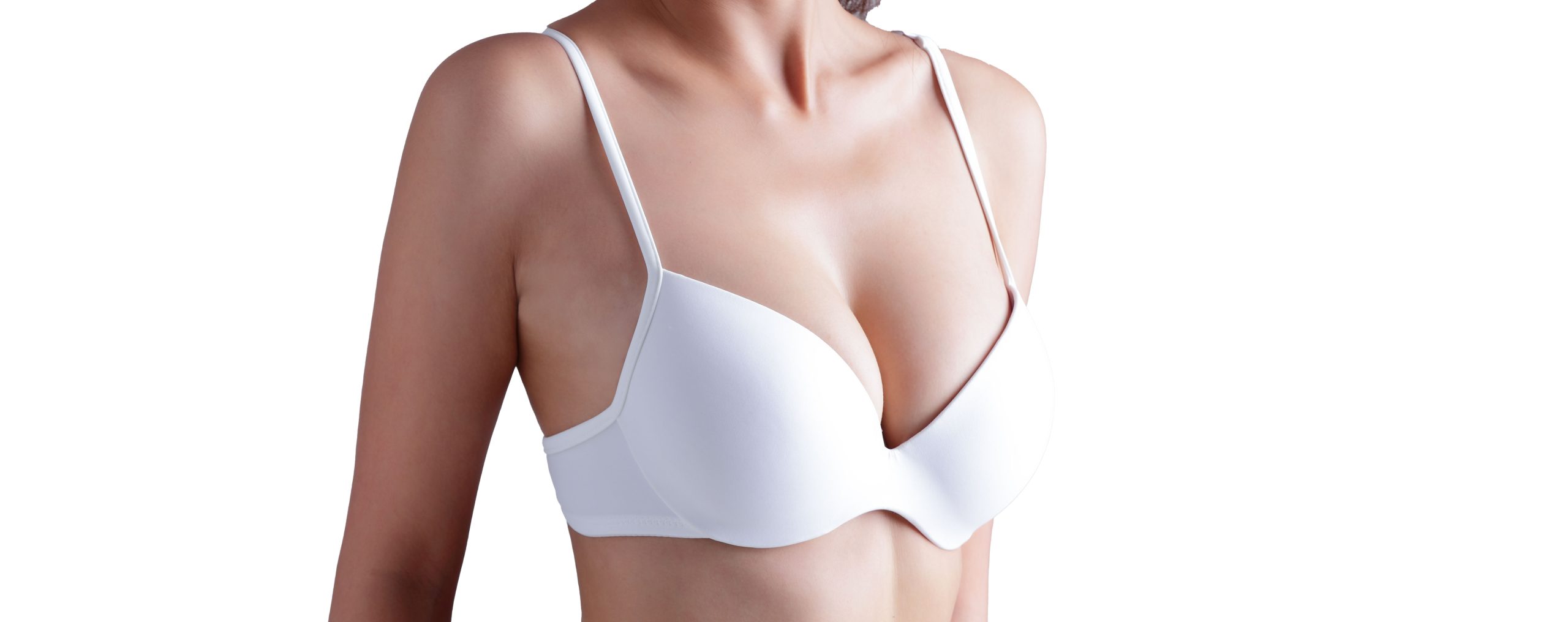
Before and after
See additional cases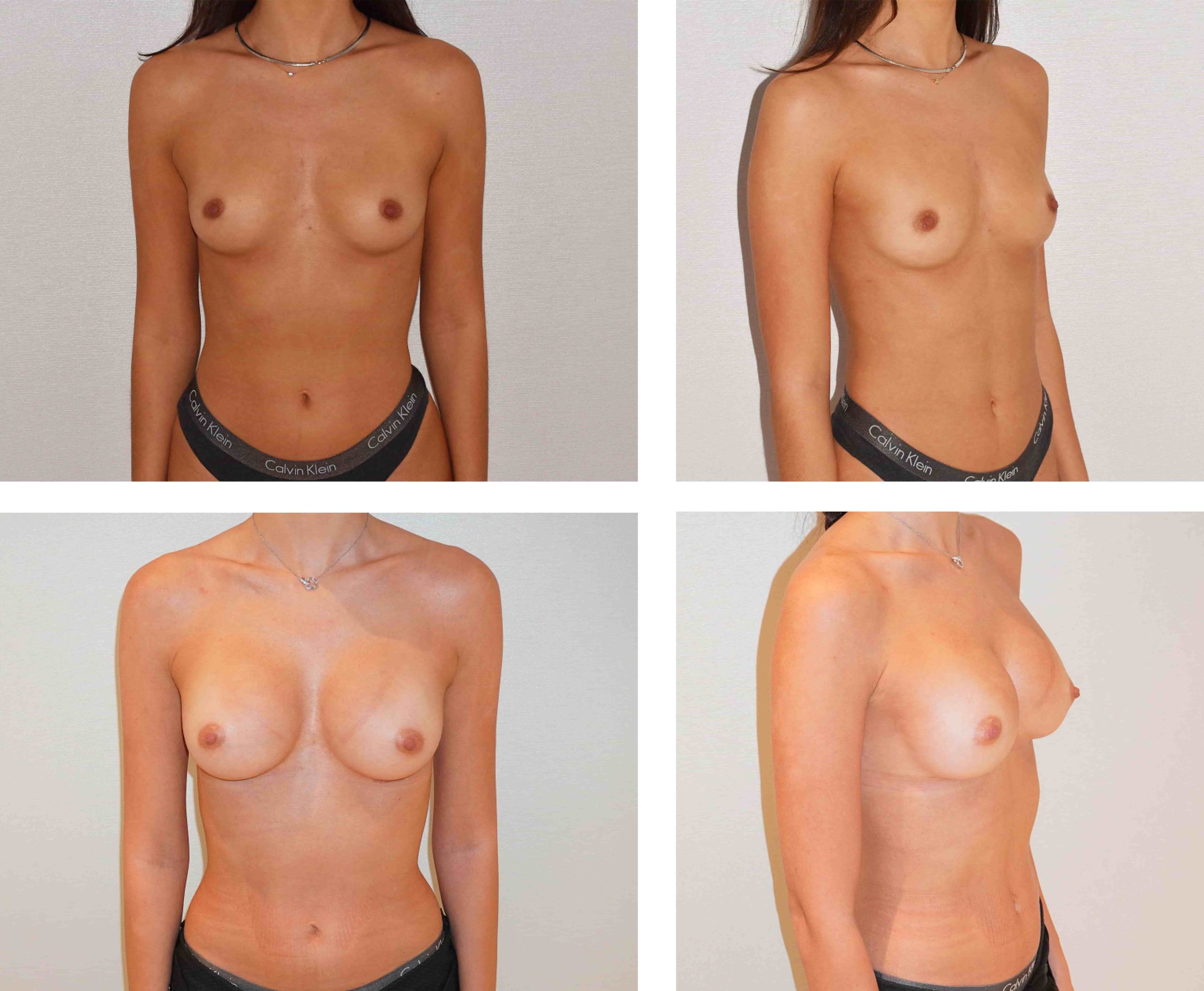
Breast Augmentation
Case 1
Individual results may vary.
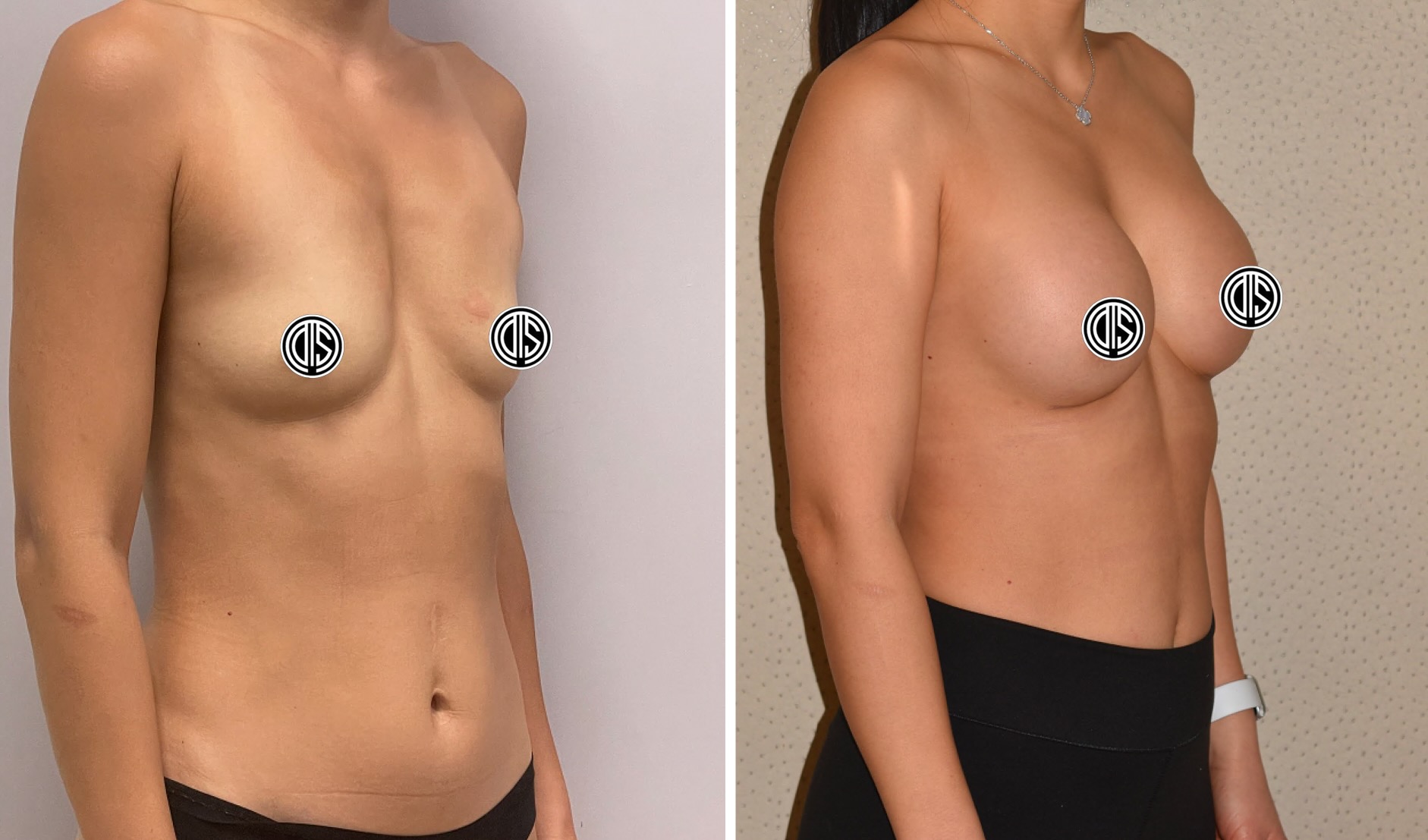
Breast Augmentation
Case 2
Individual results may vary.
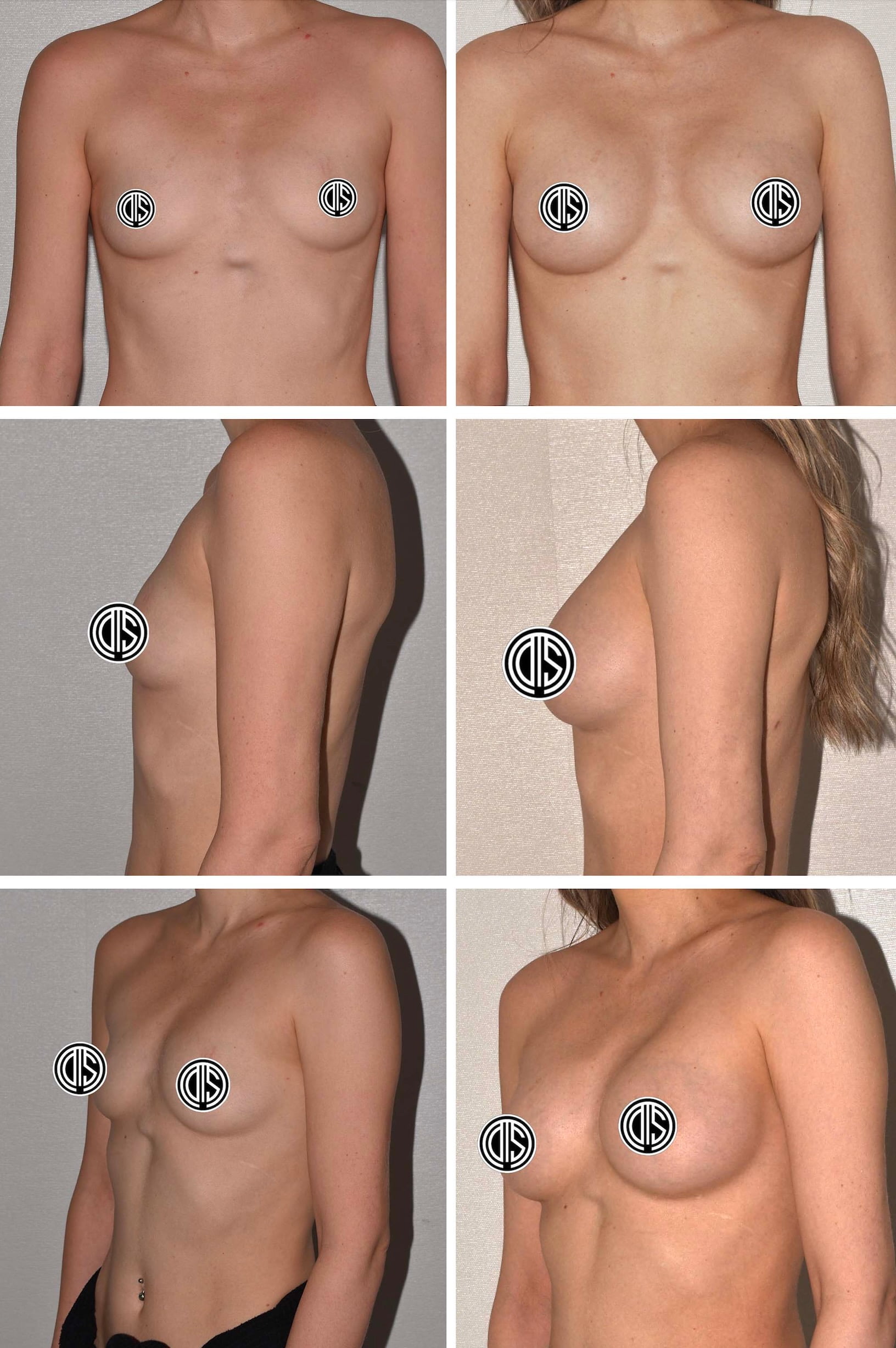
Breast Augmentation
Case 3
Individual results may vary.
Individual results may vary.
What is breast augmentation?
Breast augmentation is any procedure that makes the breasts larger. Implant surgery is the most common way that goal is reached, and fat grafting is the other reliable option. There is no dependable non-surgical way to increase breast size.
Dr. Smith frames an implant-based augmentation around four decisions: what the implant is filled with, where the incision goes, whether the implant sits over or under the chest muscle, and what size to use. Each of those is settled with the patient before surgery, and each one changes how the result looks and feels.
The operation itself usually takes about an hour. Most patients having augmentation alone plan on roughly two days before returning to desk work. This is a return-to-work milestone, not completed healing or clearance for unrestricted activity.
Choosing your implants
There are two implant fills to choose between: silicone gel and saline. The vast majority of Dr. Smith's cases use silicone gel, because in his experience it produces the best look and feel. A silicone implant is a silicone shell filled with a soft, highly cohesive gel.
Saline is still offered. A saline implant is a thin silicone shell filled with saltwater, closer to a carefully shaped water balloon, and it is the better choice for the smaller number of patients who want the certainty of knowing right away if an implant ruptures, or who would rather not have a silicone gel device.
Who makes the implant
Dr. Smith uses devices from the four FDA-approved breast implant manufacturers, and which one is used is decided case by case. The implant is selected to fit the plan rather than out of loyalty to one company: the fill, the base width, the profile and the volume are matched to the patient in front of him.
How cohesive the gel is
Firmer, more cohesive gel generally looks and feels more natural than softer gel, but Dr. Smith puts a limit on that. In his experience, gels at the extreme end of cohesivity can start to feel less natural rather than more. Cohesivity also affects what an implant costs.
Round and smooth, not teardrop
Dr. Smith uses only smooth, round implants. Teardrop-shaped implants need a textured shell to keep them from rotating, because a teardrop implant that turns in the pocket distorts the breast: its volume is unevenly distributed. A round implant can rotate without any visible consequence. Texture is also the implant surface associated with BIA-ALCL, covered below.
Three things decide the shape of the breast after surgery: the shape of the implant, its size, and its position. Dr. Smith's position is that a round implant of moderate size, placed under the pectoralis major muscle, produces the gently sloping upper pole and proportionate lower pole that patients usually mean by a teardrop breast. The teardrop look does not require a teardrop implant.
Is breast augmentation right for you?
Good candidates are in good general health, want more breast volume than their own tissue provides, and accept that an implant is a device that may need further surgery at some point. Dr. Smith also asks what kind of result a patient is after. Some patients want to look naturally busty and others want a more obviously augmented shape, and those goals lead to different plans.
What makes a case more complex
Age, a history of smoking, and previous breast implants or other breast surgery all add complexity. An augmentation in a healthy 25-year-old who has never smoked and never had breast surgery is more straightforward than one in an older patient with a smoking history and prior breast surgery.
If your concern is a narrow or constricted breast shape, read about tuberous breast correction. Dr. Smith evaluates breast shape and tissue at consultation before recommending a surgical plan.
If a lift may also be needed
Implants add volume; they do not lift the breast. When the nipple sits low relative to the fold under the breast, a lift may be recommended in addition to or instead of an implant. If childbearing is in the near future, Dr. Smith generally advises waiting on a lift, since pregnancy and breastfeeding will likely undo most of the work.
Fat transfer as an alternative
Fat grafting works for patients who want a modest increase and have enough fat to harvest. Very thin patients have little to work with, and a large increase is not realistic with fat alone. Not all transferred fat survives, so patients should be prepared for a second round. Fat grafting is also used alongside implants to build fullness in the upper pole.
Your surgical plan
Planning starts with what the patient wants to change, an examination, and a review of health history. Size is the most personal of the four decisions, and it takes in aesthetic goals and body type together. The practice uses the Canfield Vectra 3D imaging system to scan the patient and simulate different implant sizes, so the choice is made from an image of the patient's own body rather than from a number.
Size is limited by the soft tissue envelope of the breast and by what looks right on a given frame. A large implant on a small frame is more visible and produces more upper pole fullness, so it reads as less natural.
Profile and projection
Profile describes how far an implant projects forward for a given base width. Two implants of the same volume behave differently: a wider, lower-projecting implant spreads volume out across the chest, while a narrower, higher-projecting one pushes it forward. Profile is therefore the decision that separates size from shape.
The base width of the implant is matched to the base width of the breast first, and the profile then decides how much projection that width delivers. A higher profile suits a narrower chest where a low-profile implant of the same volume would be too wide for the frame. A moderate profile suits most patients and reads as the more natural result. The Vectra simulation is where that choice is settled, because projection is easier to judge on an image than to describe in words.
Where the incision goes
The inframammary incision is by far the most common approach in Dr. Smith's practice. It is a small incision, usually three to four centimeters, in the fold under the breast. It gives direct access to the plane where the implant sits without crossing much breast tissue, which is why it is thought to carry the least impact on the ability to breastfeed.
A periareolar incision runs around the lower border of the areola and requires dissecting through breast tissue and milk ducts. That brings a greater chance of interfering with breastfeeding and of infection, and with it a greater chance of capsular contracture. A transaxillary incision is made in the armpit and leaves no scar on the breast, and it crosses few milk ducts, but it carries the same raised risk of infection and capsular contracture.
Over or under the muscle
The implant goes under the pectoralis major muscle in the vast majority of Dr. Smith's cases. That puts more tissue between the implant and the outside world: implant, then muscle, then breast gland, fat, and skin. Over the muscle, the implant sits directly beneath the breast tissue.
The reason to go over the muscle is an extremely muscular, athletic patient, on the order of a professional beach volleyball player, in whom the contracting muscle would visibly deform the implant beneath it. Over the muscle also preserves more pronounced upper pole fullness for a patient who wants it.
Where the surgery is performed
Almost all of Dr. Smith's breast augmentations are performed in the private surgical center within his office at The Ritz Tower. The facility is accredited by QUAD A. The same team, instruments and protocols are used every time, and anesthesia is delivered only by board-certified anesthesiologists.
Anesthesia for breast augmentation
Breast augmentation is performed under general anesthesia in most cases. IV sedation is an option in selected cases, and the decision is made at consultation. Anesthesia is administered by a board-certified anesthesiologist in the practice's QUAD A accredited operating room.
The Preservé technique can be performed under general anesthesia, IV sedation, or in some cases local anesthesia.
Recovery and follow-up
Most patients take about two days off work after breast augmentation alone. A common pattern in the practice is surgery on a Friday and a return to a desk job on Monday. Soreness is usually manageable with Tylenol by about 48 hours after surgery, often sooner.
Patients are asked to avoid exercise, especially upper body work, for at least two weeks. Augmentation combined with a breast lift takes longer: the practice generally advises five to seven days off a desk job, because a lift involves more tissue manipulation and takes longer to heal. Written instructions covering activity, incision care, and follow-up are provided individually.
Explore our breast augmentation recovery guide for a closer look at activity, support and follow-up after surgery.
The garment schedule
A surgical bra is worn for the first two weeks, then a sports bra for four weeks, and after that any bra or none. The garment supports the breast while the pocket heals and the implant settles, which is why the schedule is worth keeping to even once the breasts are comfortable without it.
Follow-up and who provides it
Patients are seen the morning after surgery, then at one week, two weeks, one month, three months, six months and one year. That is the minimum schedule, and patients are welcome to come in as often as they want beyond it.
Dr. Smith leads all post-operative care. He and the practice's physician assistant see post-operative patients together, and he is present for every major visit; some minor visits may be with the physician assistant alone. The result is continuity from the surgeon who performed the operation, with a dedicated physician assistant so that patients can be seen as often as they need rather than rationed into a fixed number of appointments.
How the result settles
Implants sit high on the chest at first, with exaggerated upper pole fullness, and then settle. As the chest tissue relaxes, the implant drops into its final position. This usually happens within a few weeks to a few months, but it varies a great deal between patients and the timing is difficult to predict.
What does breast augmentation cost?
A quote from the practice is itemized into a surgeon's fee, a facility fee and an anesthesia fee, with the implants a device cost within it. All post-operative visits are included in the quote. Other items are not, and anything falling outside those fees is identified when the quote is given. A quote is valid for 30 days, and a 10 percent deposit is taken at booking.
The surgeon's fee reflects the complexity of the case, the surgeon's training, whether they are certified by the American Board of Plastic Surgery, how many of these operations they perform, and their reputation. The anesthesia fee depends on who delivers the anesthesia and how long the case takes. The facility fee covers being in the operating room, including disposable supplies and sterilization of reusable instruments. Implant cost depends on the fill type, and among silicone implants on how cohesive the gel is.
If a revision is needed
For one year after surgery there is no surgeon's fee on a revision. The patient remains responsible for the anesthesia and facility fees, because those are paid out to the anesthesiologist and for running the operating room. Implants are devices, and some patients eventually need a further operation, so the policy is stated up front rather than negotiated afterward.
Consultation, financing, and insurance
A consultation is $500, applied toward any procedure booked, and it is never waived. Financing is available through CareCredit and Alphaeon Credit. Dr. Smith is out of network with all insurance plans; the practice helps patients use out-of-network benefits toward care.
Safety and long-term care
Breast augmentation is surgery and carries real risks, including bleeding, infection, poor scarring, changes in nipple and skin sensation, asymmetry, problems with anesthesia, and the possibility of further surgery. Implants add device-specific risks on top of those.
Capsular contracture
A scar capsule forms around every implant, and that is normal. In a small number of cases that capsule contracts around an implant of fixed volume, which can cause pain and change the implant's shape or position. Dr. Smith describes it as an uncommon complication. When it happens, the implant often has to be removed and replaced.
Rupture and screening
A saline implant that ruptures deflates like a water balloon and the breast visibly loses volume, so there is no question about what happened. A silicone gel implant often holds its shape when it ruptures, because modern cohesive gels largely stay put, so a rupture can go unnoticed. The FDA recommends imaging to screen for silent rupture: either MRI or ultrasound, beginning five to six years after placement, then repeated every two to three years.
BIA-ALCL
BIA-ALCL is a rare cancer of the immune system that has been identified in patients with all types of textured breast implants. There are no confirmed cases involving only a smooth implant, but the records of many diagnosed women did not specify the implant surface, so that finding comes with a stated limitation. Dr. Smith uses only smooth, round implants.
Squamous cell carcinoma and other cancers in the capsule
Cancers other than BIA-ALCL have been reported in the scar tissue around breast implants. The FDA states that scientific literature and medical device reports include squamous cell carcinoma and lymphomas other than BIA-ALCL in that capsule. These reports are rare and the FDA has not published an incidence rate, has not linked them to a particular implant surface, and describes the picture as still emerging. The practical point for a patient is the same as for any implant: swelling, pain, a lump or a change in the breast that appears years after surgery is worth having examined rather than waiting out.
Systemic symptoms, sometimes called breast implant illness
Some patients with implants report systemic symptoms including fatigue, memory difficulty, rash and joint pain. The FDA recognizes these reports and states plainly that the symptoms and what causes them are poorly understood. There is no diagnostic test and no established mechanism. The FDA also notes that in some cases removal without replacement is reported to reverse them. Dr. Smith accepts patients who want their implants removed for these symptoms, and looks for other explanations first so that a treatable condition is not missed. Breast implant removal covers this in full.
How long implants last
Breast implants are not lifetime devices. How long they last varies, and further surgery may be needed because of an implant problem or changes in the breasts over time. Follow-up care helps you review the condition of your implants and whether your goals have changed.
What is required before surgery
No nicotine in any form for four weeks before surgery and four weeks after. Cigarettes, vaping, pouches, patches and gum all count, and the practice tests for it. Nicotine narrows the small vessels that supply healing tissue, and in breast surgery that shows up as delayed healing, wound problems and worse scars.
Your preoperative plan includes a review of your medical history, medications and supplements, and any testing needed before anesthesia. Follow the instructions agreed with your surgical team and prescribing clinician; do not stop prescribed medication on your own. Dr. Smith will also discuss weight stability and any other preparation relevant to your procedure.
Your questions
How long is recovery after breast augmentation?
For breast augmentation alone, patients generally plan about two days before returning to desk work. This is a return-to-work milestone, not completed healing or clearance for unrestricted activity. Patients often have surgery on a Friday and return to a desk job on Monday, with soreness manageable on Tylenol by about 48 hours. No exercise, especially upper body work, for at least two weeks. A surgical bra is worn for two weeks, then a sports bra for four weeks. Augmentation with a lift usually means five to seven days off.
Are silicone or saline implants better?
Silicone gel gives the more natural look and feel, and the vast majority of Dr. Smith's cases use it. Saline is still offered, and it is the better choice for the smaller number of patients who want to know immediately if an implant ruptures, or who prefer not to have a silicone gel device.
Is there a minimum age for breast implants?
For cosmetic breast augmentation, FDA-approved saline implants are indicated for women 18 and older, and silicone gel implants for women 22 and older. Reconstruction has different indications. These ages describe device labeling; Dr. Smith also considers your health, anatomy and goals when evaluating whether surgery is appropriate.
Where is the incision for breast augmentation?
Usually in the fold under the breast. That inframammary incision is three to four centimeters and is by far the most common approach in Dr. Smith's practice, because it reaches the implant pocket directly without crossing much breast tissue. Incisions around the areola or in the armpit are alternatives.
When will I be seen after surgery?
The morning after surgery, then at one week, two weeks, one month, three months, six months and one year. That is the minimum, and patients can come in as often as they want. Dr. Smith leads all post-operative care and is present for every major visit, seeing patients together with the practice's physician assistant.
Do implants go over or under the muscle?
Under the pectoralis major muscle in the vast majority of cases, because more tissue covers the implant. Over the muscle is reserved for the very muscular, athletic patient in whom the contracting muscle would visibly deform an implant beneath it, or for a patient who specifically wants more upper pole fullness.
How long do breast implants last?
Breast implants are not lifetime devices. How long they last varies, and further surgery may be needed because of an implant problem or changes in the breasts over time. Follow-up care helps you review the condition of your implants and whether your goals have changed. For one year after surgery the practice charges no surgeon's fee on a revision.
Can I breastfeed after breast augmentation?
In the majority of cases yes, because the disruption to the milk ducts tends not to be severe. The incision matters: the inframammary approach crosses the least breast tissue. Dr. Smith is also candid that for patients who have not breastfed before surgery, their baseline ability is unknown.
Do breast implants look too high at first?
Yes, and that is expected. Implants sit high with exaggerated upper pole fullness immediately after surgery, then settle as the chest tissue relaxes. This usually happens within a few weeks to a few months, and the timing is difficult to predict.
Do silicone implants need MRI screening?
The FDA recommends screening with either MRI or ultrasound, beginning five to six years after placement and repeated every two to three years. The reason is silent rupture: a cohesive gel implant can rupture without any change in the shape of the breast.
Can fat transfer replace implants?
Only for a modest increase. Fat grafting is limited by how much fat a patient has to harvest and by how much of it survives, so a significant increase in size calls for implants. Patients choosing fat should be prepared for a second grafting procedure.
Do I need a breast lift as well as implants?
It depends on where the nipple sits relative to the fold under the breast. An implant adds volume but does not lift the breast, so when there is meaningful sagging a lift may be recommended alongside or instead of an implant. A lift leaves permanent scars.
What is included in a breast augmentation quote?
The surgeon's fee, the facility fee and the anesthesia fee, itemized separately, plus the implants. All post-operative visits are included; other items are not. The quote is valid for 30 days and a 10 percent deposit is taken at booking. Consultations are $500 and applied toward any procedure booked.