
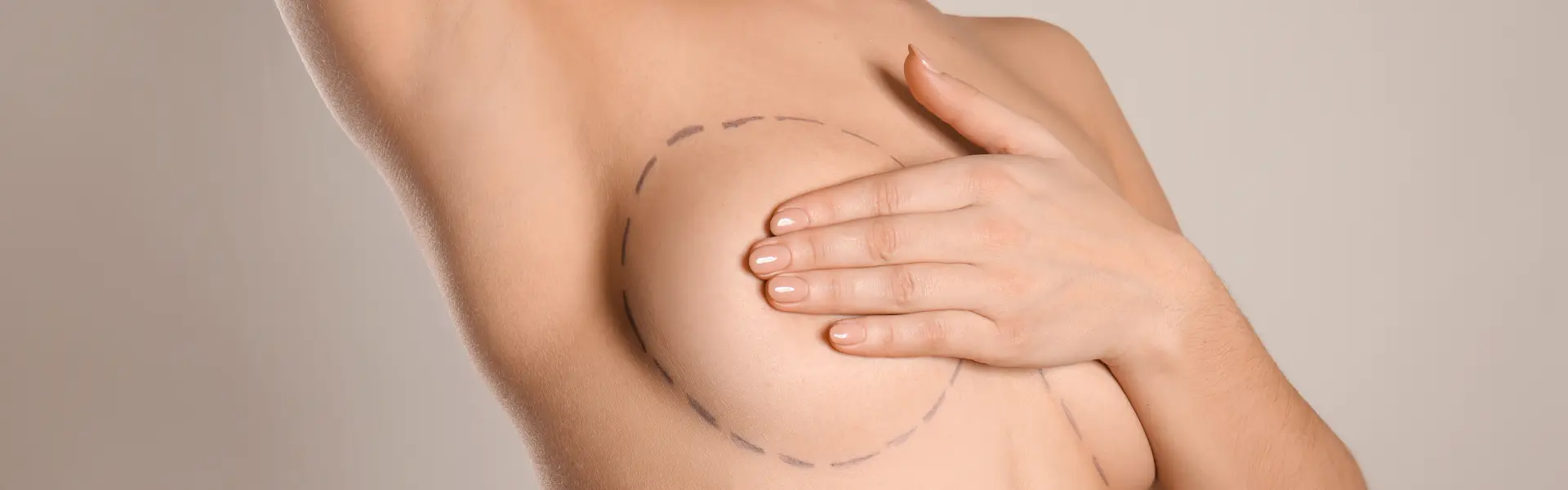
What is tuberous breast deformity?
Tuberous breast deformity is a developmental variation in which the base of the breast is constricted and the lower half never fills out, so the breast grows forward into a narrow, conical or tube-like shape instead of a round one. It is also called tubular breast or constricted breast. Many patients arrive at a consultation having lived with the shape for years without knowing it had a name.
It is not a disease, and it is not caused by anything a patient did. It has nothing to do with weight, exercise, diet or bras. The shape is set during puberty, when connective tissue at the base of the breast does not yield as the breast grows. The exact cause is not established; published explanations center on an abnormality of the superficial fascia at the breast base, sometimes described as a constricting fibrous ring, with a hormonal influence at puberty and a genetic difference present before birth both proposed.
How common it is is genuinely unclear. Estimates run from a few percent to more than a quarter of women depending on how strictly the condition is defined, and one systematic review states that the true incidence is unknown. Mild forms are common and often unrecognized.
It can be corrected surgically, and Dr. Smith performs this correction frequently. His approach is usually a single operation through an incision at the border of the areola, releasing the constricted lower pole with radial scoring, lowering the fold under the breast, and adding volume, most often with an implant and sometimes with fat. How much of that a given breast needs depends on how pronounced the features are. A consultation is where an individual plan is made.
The features that define it.
Tuberous breast deformity is recognized by a cluster of features rather than any single one, and a patient may have all of them or only some. Each also occurs in breasts that are not tuberous, so it is the combination that matters.
A constricted breast base
The footprint of the breast on the chest wall is too narrow. A normally developed breast sits on a base that spreads across the chest; a tuberous breast projects forward off a small foundation, tight in width and often in height. This gives the shape its tubular appearance, drives most of the other features, and usually leaves a wide gap between the two breasts.
A deficient lower pole
The bottom half of the breast is underfilled. Tissue that should have expanded into the lower quadrants did not, so volume sits high and behind the nipple instead of spreading below it. The effect is little fullness beneath the areola, a short distance from the nipple down to the fold, and a nipple that points downward or straight ahead rather than slightly up.
An inframammary fold that sits too high
The crease under the breast is higher on the chest than it should be, which shortens the breast from top to bottom and caps how far the lower pole can fill. It may be elevated along its whole length or only on one side, which tilts the breast. The fold is a real anatomical structure rather than a skin crease, so it does not stretch out of the way when volume is added. That is why placing an implant without addressing the fold often produces a poor result.
Areolar herniation and a wide areola
Breast tissue pushes forward into the areola instead of spreading into the lower pole, so the areola bulges and stretches. The result is an areola that looks large relative to the breast, often domed or puffy, sometimes described by patients as the breast sitting inside the areola. The fascial support beneath the areola is thin while the tissue at the base is tight, so a growing breast takes the path of least resistance.
Asymmetry between the sides
The two breasts are frequently affected to different degrees, and sometimes only one is affected. One side may be smaller, more constricted, or carry a higher fold and a larger areola. Asymmetry is common enough here that it is treated as part of the condition, and it is a main reason the two sides may need different operations.
How surgeons grade it.
Surgeons grade tuberous breast by how much of the breast is underdeveloped, because the grade predicts how much work the correction takes. The system most used in the literature is Grolleau's, with three grades.
- Type I: only the lower inner quadrant is underdeveloped. The mildest and most easily missed form.
- Type II: both lower quadrants are underdeveloped, so the whole bottom half of the breast is deficient.
- Type III: all four quadrants are involved, with severe constriction of the base. The breast is small, tight and markedly narrow.
At least eight classification systems have been published, and another widely cited scheme adds a fourth grade and accounts for whether the skin beneath the areola is deficient as well as the breast tissue. There is no agreed standard, which is part of why published prevalence figures disagree so sharply.
The higher the grade, the more tissue has to be released, the more volume has to go into a smaller and tighter space, the more likely correction takes more than one operation, and the higher the published complication and revision rates. A Type I breast often needs a modest release and moderate added volume. A Type III breast is a reconstructive problem.
How Dr. Smith corrects tuberous breasts.
Correction is not an augmentation with a bigger implant. Dr. Smith performs this operation frequently and his approach is consistent: a periareolar incision, radial scoring to release the constricted lower pole, lowering of the fold under the breast, and volume added with an implant in most cases and with fat in some. Those steps address the three problems in order, which are the tissue holding the breast in, the lack of anywhere for the lower pole to expand into, and the missing volume itself.
A periareolar incision
The incision is made at the border of the areola. It gives direct access to the constricting tissue, which sits immediately behind and below the areola, and it is also the incision through which a stretched or herniated areola is reduced when that is part of the plan. The scar falls at the edge of pigmented skin, where it generally settles well. In a routine breast augmentation Dr. Smith uses the fold under the breast instead, but a tuberous breast needs the exposure the areolar route gives and frequently needs work on the areola itself.
Radial scoring to release the constriction
Radial scoring is a series of controlled cuts made from inside the breast, running outward from the center like the spokes of a wheel, through the tight fascia and glandular tissue at the base. The scored tissue opens out and lets the lower pole expand rather than resist. Without a release of this kind, added volume pushes forward through the areola and reproduces the original shape at a larger size, which is why a tuberous breast treated as an ordinary augmentation usually looks worse rather than better. Almost every published technique for this condition begins with some version of this step.
Lowering the fold
The crease under a tuberous breast usually sits too high, and it is a real anatomical structure rather than a skin crease, so it does not move out of the way when volume is added. Dr. Smith releases it from the chest wall and resets it lower, where the bottom of the breast should sit. That lengthens the breast from the nipple down and gives the released lower pole somewhere to fill. The new fold has to be created and supported while it heals, and setting it too low creates a deformity of its own, so the distance is planned rather than improvised.
Adding volume
Volume comes from an implant in most cases and from the patient's own fat in some. An implant gives a predictable, immediate change in size and is the more common route both in Dr. Smith's practice and in the published series. Fat grafting avoids a device and can be layered into the released lower pole, but it depends on having enough fat to harvest, not all of it survives, and it usually takes more than one session. Implant choice and placement in general are covered on the breast augmentation page, though the decisions here are more constrained by the tissue.
Correcting the areola
A wide or herniated areola is reduced in diameter and, where tissue has domed forward, flattened back into the breast. The periareolar incision is already in the right place for it, so this is done through the same access rather than adding a scar. Where the areola is not stretched, the step is not needed.
Treating the sides differently
Where the breasts differ, the operations differ: different implant sizes or profiles, more release on one side, an areolar reduction on one side only. The goal is symmetry of the result, not symmetry of the operation.
Which combination applies is settled at consultation, after an examination and a discussion of what the patient wants the result to look like. Book a consultation for a plan specific to your anatomy.
One operation or two.
Usually one. Dr. Smith completes most tuberous breast corrections in a single operation, releasing the constriction, lowering the fold and adding volume in the same sitting. Single-stage correction is also the more common approach in the published literature; in one systematic review, twenty of the twenty-nine studies reporting it used a single-stage approach and nine used a multistage approach.
Several things push a particular case toward a second stage.
- Fat as the volume source. Fat grafting is a multi-session technique by nature, since only part of each graft survives and the volume is built up over more than one procedure. Implant-based correction is the version that is done in one stage.
- Severity. A tightly constricted breast with a small skin envelope may not safely accept in one sitting all the volume a proportionate result requires, and forcing it puts tension on the incisions and on the blood supply to the skin and areola.
- Refinement after the shape settles. Tuning the areola, the fold or the match between the two sides is a more accurate judgment once the breast has settled, so a small second procedure is sometimes planned for later.
Tissue expansion, in which an expander is placed and filled over weeks before being exchanged for an implant, appears in the literature for the most severe grades and is staged by definition. Staging is not a sign that something went wrong. Where it is chosen it is usually the plan from the outset, and it is discussed before surgery rather than raised afterward.
What the results are realistically like.
The goal is a breast that looks normal in and out of clothing, not a perfectly matched pair. Tuberous breast correction is a harder operation than a straightforward augmentation, and being clear about what it delivers is more useful than a promise it cannot keep.
Some asymmetry is likely to persist. The breasts start out different, are operated on differently, and heal differently. A good result is one where the difference is not what gets noticed in the mirror or in clothing.
A second procedure is more likely here than after a routine augmentation, most often to refine the areola, the fold, or the match between the two sides. Complication and revision rates reported in the published literature are higher for this operation than for routine augmentation, which follows from how much tissue has to be released and how much volume goes into a small space. Dr. Smith's practice charges no surgeon's fee on a revision within one year of surgery, which is set out in the cost section below.
Scars are permanent. The correction is made through an incision at the border of the areola, and where an areolar reduction is performed the scar runs the whole way around it. Areolar scars generally settle well because they sit at the edge of pigmented skin, but they do not disappear.
Against all of that, published patient-reported satisfaction after this operation is consistently high, including among patients who needed more than one procedure. Patients who have lived with the shape for years tend to be pleased with a correction even when it takes refinement to get there.
Recovery after tuberous breast surgery.
Recovery depends on which operation is performed, so the ranges below are general. Written, individual instructions covering activity, incision care and follow-up are provided before surgery.
An implant-based correction recovers broadly like an augmentation with a lift: a few days before returning to desk work for most patients, longer where extensive tissue rearrangement or an areolar reduction has been done, with exercise restricted for a period of weeks. Correction with fat grafting adds recovery at the donor sites; patient information published by academic centers describes on the order of ten days to two weeks before normal activity. A staged correction has a recovery period after each stage.
The garment schedule
After an implant-based correction the practice's breast garment schedule applies: a surgical bra for the first two weeks, then a sports bra for four weeks, and after that any bra or none. Where fat has been grafted, compression is worn on the area the fat was taken from for four weeks, which is the practice's rule after any liposuction.
Follow-up and who provides it
Patients are seen the morning after surgery, then at one week, two weeks, one month, three months, six months and one year. That is the minimum schedule, and patients are welcome to come in as often as they want beyond it.
Dr. Smith leads all post-operative care. He and the practice's physician assistant see post-operative patients together, and he is present for every major visit; some minor visits may be with the physician assistant alone. In an operation that reshapes the breast in stages of healing rather than all at once, that means the surgeon who did the release and set the fold is the one following how it settles, with a dedicated physician assistant so patients can be seen as often as they need rather than rationed.
The shape takes months to settle in every version of this operation. Released tissue relaxes, an implant descends into the lower pole, grafted fat resolves to the volume that survives, and a reset fold matures. Judging the result in the first weeks is judging it too early.
Risks.
This operation carries the risks of any breast surgery plus risks specific to the techniques used. General risks include bleeding, infection, poor or widened scarring, changes in nipple and skin sensation, delayed healing, asymmetry, problems related to anesthesia, and the possibility of further surgery.
Risks specific to this correction
Because the operation releases tissue and resets the fold, it carries a particular risk of double bubble deformity, in which the original constricting fold stays visible as a line across the lower breast beneath the new one. Persistent or recurrent constriction, under-correction of the lower pole, and widening of the areolar scar are the other technique-specific problems reported. Where an areolar reduction is performed, nipple sensation can change and breastfeeding can be affected, although breast development itself already affects milk production in some women with this condition.
If implants or fat are used
Implants add capsular contracture, rupture, malposition and eventual exchange to the list, and they are not lifetime devices. The FDA recommends screening for silent rupture of silicone gel implants with either MRI or ultrasound, beginning five to six years after placement and repeated every two to three years. Fat grafting instead adds the risks of the liposuction used to harvest the fat, along with fat necrosis, oil cysts, calcifications and unpredictable volume retention.
What is required before surgery
No nicotine in any form for four weeks before surgery and four weeks after. Cigarettes, vaping, pouches, patches and gum all count, and the practice tests for it. This matters more here than in most breast operations: the correction depends on released tissue and a repositioned areola healing with a good blood supply, and nicotine narrows the small vessels that carry it.
Any supplement or medication that can act as a blood thinner stops ten days before surgery. Medical clearance and laboratory work are required for cases done under anesthesia, with an EKG for patients over 40, and laboratory work for cases done under local. Weight should be stable for three months before operating.
Where surgery is performed
The practice has an accredited outpatient surgical facility within the office at The Ritz Tower on East 57th Street, accredited by QUAD A and anesthesia is delivered only by board-certified anesthesiologists. Where a given operation is performed, and what anesthesia it calls for, follows from the plan and is discussed at consultation. Dr. Smith is board-certified by the American Board of Plastic Surgery.
What drives the cost of tuberous breast surgery.
A surgical quote is made of four parts: the surgeon's fee, the anesthesia fee, the facility fee, and the cost of any implants. Tuberous breast correction sits at the more expensive end of breast surgery because of what each part has to cover. The surgeon's fee reflects complexity, and releasing a constricted base, resetting a fold, reducing an areola and matching two asymmetric sides is more work than placing an implant. Anesthesia and facility fees track the length of the case. Implant cost applies only if implants are used, and fat grafting substitutes liposuction time for implant cost, which does not necessarily make it cheaper.
A quote from the practice is itemized into a surgeon's fee, a facility fee and an anesthesia fee, with implants a device cost within it where they are used. All post-operative visits are included, so the follow-up schedule above carries no separate charge and neither do the extra visits patients ask for. Other items are not included, and anything falling outside those fees is identified when the quote is given. A quote is valid for 30 days, and a 10 percent deposit is taken at booking. A staged plan means more than one set of fees.
If a revision is needed
For one year after surgery there is no surgeon's fee on a revision. The patient remains responsible for the anesthesia and facility fees, which are paid out to the anesthesiologist and for running the operating room. That policy matters more in this operation than in most, because refinement of the areola, the fold or the match between the sides is a realistic part of the plan rather than a remote possibility.
Consultation, financing and insurance
A consultation is $500, applied toward any procedure booked, and never waived. Financing is available through CareCredit and Alphaeon Credit. Dr. Smith is out of network with all insurance plans; the practice helps patients use out-of-network benefits toward care. The American Society of Plastic Surgeons takes the position that surgery to correct a congenital breast deformity is reconstructive rather than cosmetic, but that is a position on classification and not a statement that any given plan will be covered.
Your questions about tuberous breast surgery.
How do I know if I have tuberous breasts?
The recognizable pattern is a narrow breast base, little fullness in the lower half of the breast, a short distance from the nipple to the fold, an areola that looks large or puffy relative to the breast, and often a wide gap between the two breasts. Any one of these occurs in breasts that are not tuberous, so it is the combination that matters. Only an examination can settle it.
Is tuberous breast deformity my fault?
No. It is a developmental variation set during puberty, before anyone has any say in it. It is not caused by weight, exercise, diet, posture or bras. The exact cause is not established, but it involves connective tissue at the base of the breast failing to yield as the breast grows.
Is it a disease, and is it dangerous?
No. It is a variation in how the breast developed, not an illness, and it does not require treatment. Correction is elective. Patients seek it because of the shape, not because the condition threatens health.
Will tuberous breasts get worse over time?
The underlying constriction is established at puberty, and nothing in the published literature describes it as progressive. Tuberous breasts do change in the ordinary way with pregnancy, breastfeeding, weight change and age, and those changes can make the existing shape more or less noticeable. That is not the same as the deformity itself worsening.
Will implants alone fix tuberous breasts?
Usually not. An implant placed into a breast whose base is still constricted and whose fold is still high makes the existing shape larger rather than changing it, and it pushes tissue further forward into the areola. Dr. Smith releases the constricted lower pole with radial scoring and lowers the fold before adding volume, which is what turns an augmentation into a correction. Whether an implant alone is reasonable in a very mild case is a question for an examination.
Can tuberous breasts be corrected in one operation?
Usually yes. Dr. Smith completes most tuberous breast corrections in a single operation, and single-stage correction is also the more common approach in the published literature. A second stage is planned when fat is the source of volume, when the breast is so tightly constricted that the skin envelope cannot safely accept the necessary volume at once, or when refining the areola and the match between the two sides is better done after the shape has settled.
Can it be corrected with fat instead of implants?
Yes, in appropriate cases, though an implant is the more common choice. Dr. Smith uses an implant in most corrections and fat in some. Fat grafting adds volume to the released lower pole without a device and avoids the long-term maintenance implants carry, but it requires enough fat to harvest, usually takes more than one session, and only part of each graft survives. An implant gives a larger, more predictable change in a single operation.
Will my breasts be symmetrical afterward?
Closer, but not identical. Tuberous breasts usually start asymmetric, the sides are often operated on differently, and they heal differently. A good result is one where the difference is not what gets noticed in the mirror or in clothing. Exact symmetry is not achievable in breast surgery, and it is less achievable here than in a routine augmentation.
How likely is a second operation?
More likely than after a routine breast augmentation, and most corrections are still done in one. Where a second procedure is needed it is usually a refinement of the areola, the fold or the match between the two sides rather than a repeat of the whole operation. Published revision rates vary widely by technique and severity, so no single figure is the rate. For one year after surgery the practice charges no surgeon's fee on a revision; the patient is responsible for the anesthesia and facility fees.
Can I breastfeed after tuberous breast correction?
Possibly, but it cannot be guaranteed, and the condition itself is relevant. Some women with tuberous breasts have reduced milk production because of how the glandular tissue developed, independent of any surgery. Surgery around the areola can affect the ducts. Anyone for whom future breastfeeding matters should raise it at consultation.
What scars does the correction leave?
A scar at the border of the areola. Dr. Smith uses a periareolar incision for this correction, and where an areolar reduction is part of the plan the scar runs the whole way around the areola. Scars at the edge of pigmented skin generally settle well, but they are permanent, and which ones a given plan would leave should be established before agreeing to surgery.
Is there a right age for correction?
Correction is generally deferred until breast development is complete, since operating on a breast that is still developing risks a result that changes underneath it. Beyond that there is no set age. Patients considering pregnancy in the near future should discuss timing at consultation.