

What thigh liposuction does, and the four walls of the thigh.
Thigh liposuction removes localized fat through incisions of about two to three millimeters, reducing the circumference of the leg and improving its contour. It treats fat only. It does not remove skin, and the quality of the skin over the fat decides how much fat can safely come out.
Dr. Smith describes the thigh as having four walls: the inner thigh, the outer thigh, the anterior or front of the thigh, and the posterior thigh, which includes the banana roll beneath the buttock. Each behaves differently. The thigh is assessed as a 360 degree structure before a plan is designed, because treating one wall in isolation can leave the leg uneven from another angle.
Where elasticity is good, skin contracts and shrink wraps itself onto the smaller shape underneath. Where it is not, removing that volume leaves loose skin with less to fill it. How liposuction works across the body is covered on the liposuction page.
BEFORE & AFTER PHOTOGRAPHS
Legs gallery
Explore photographs from our legs gallery. Individual results vary.
Photo 92
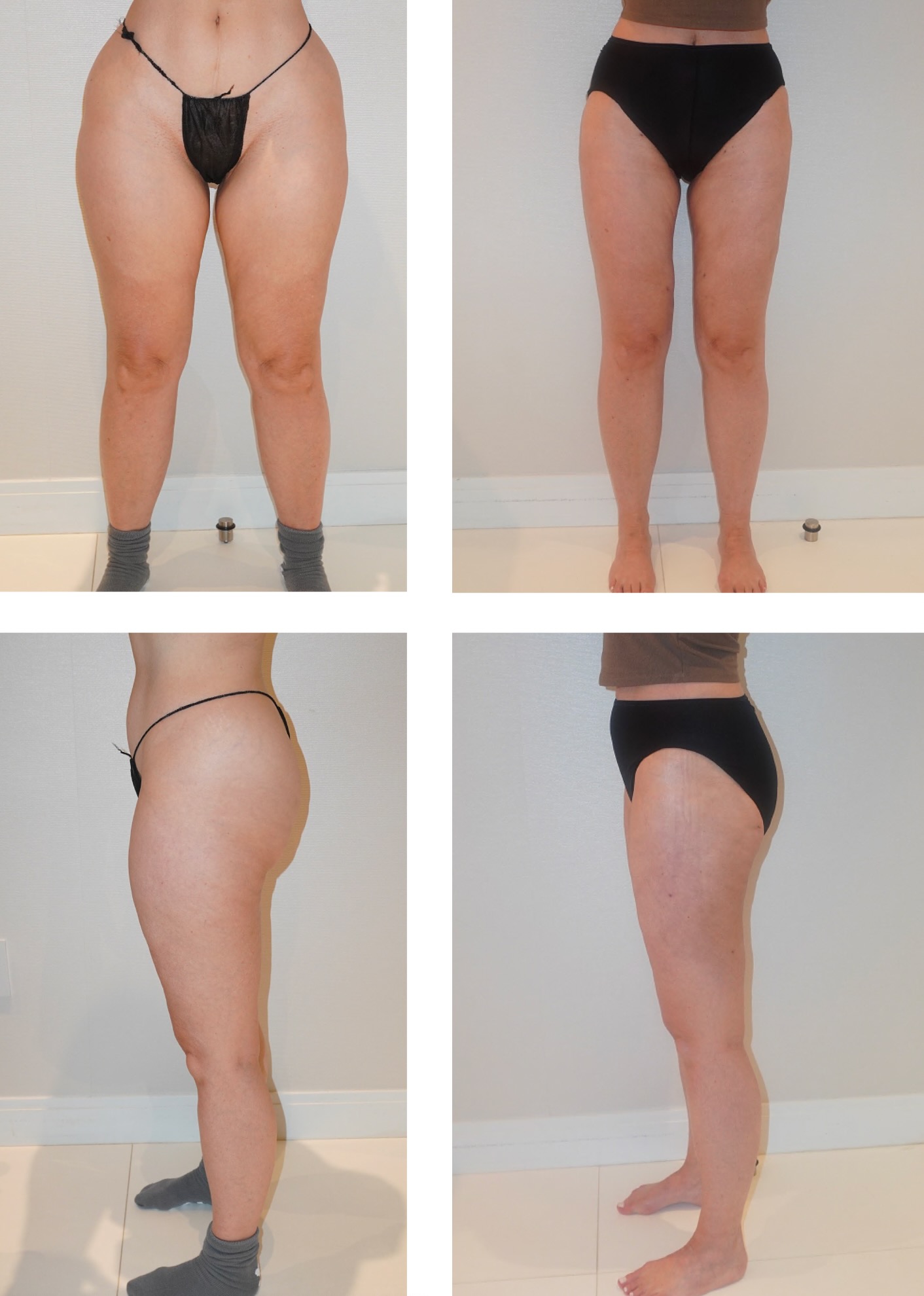
Photo 102
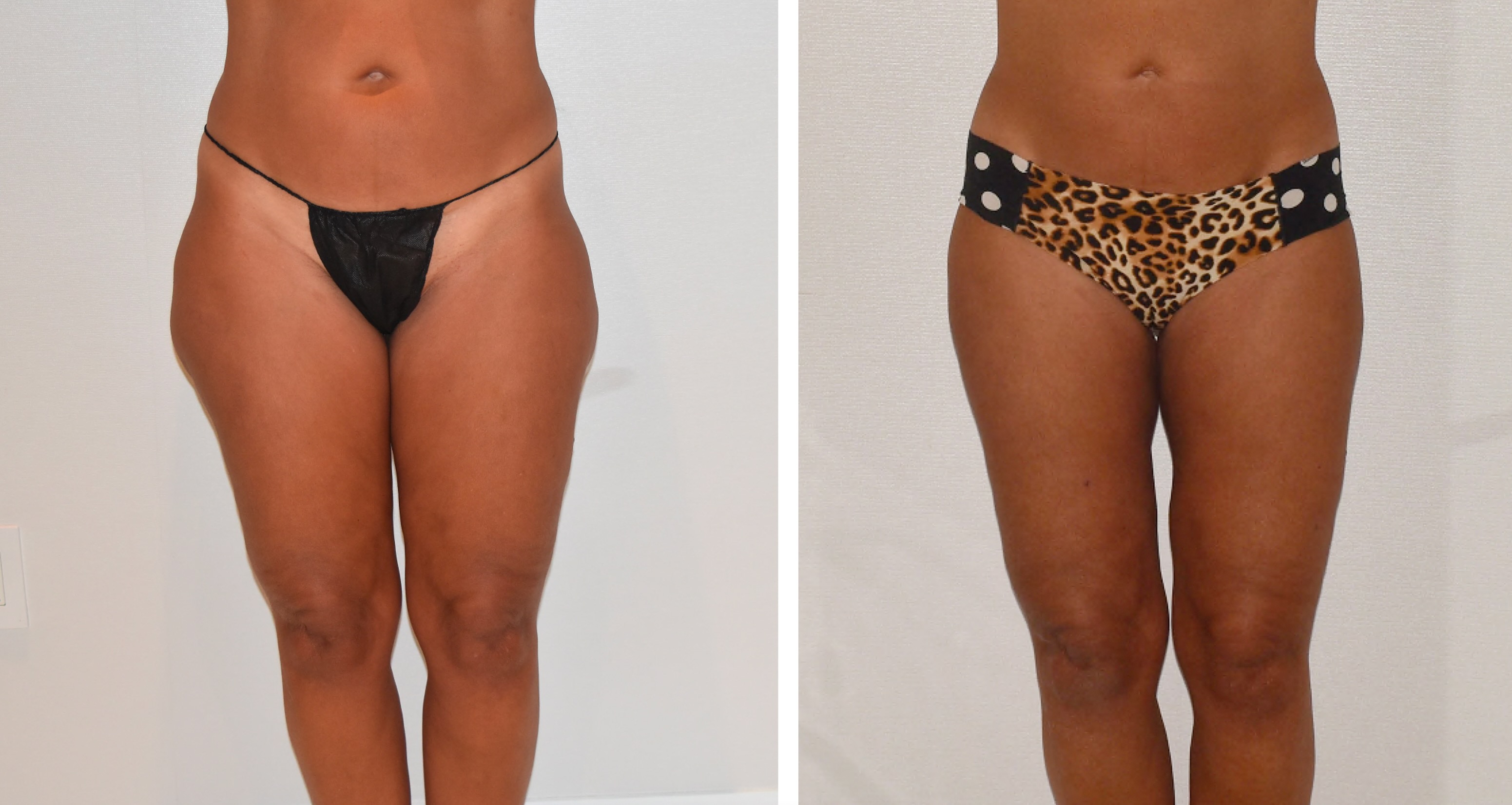
Photo 103
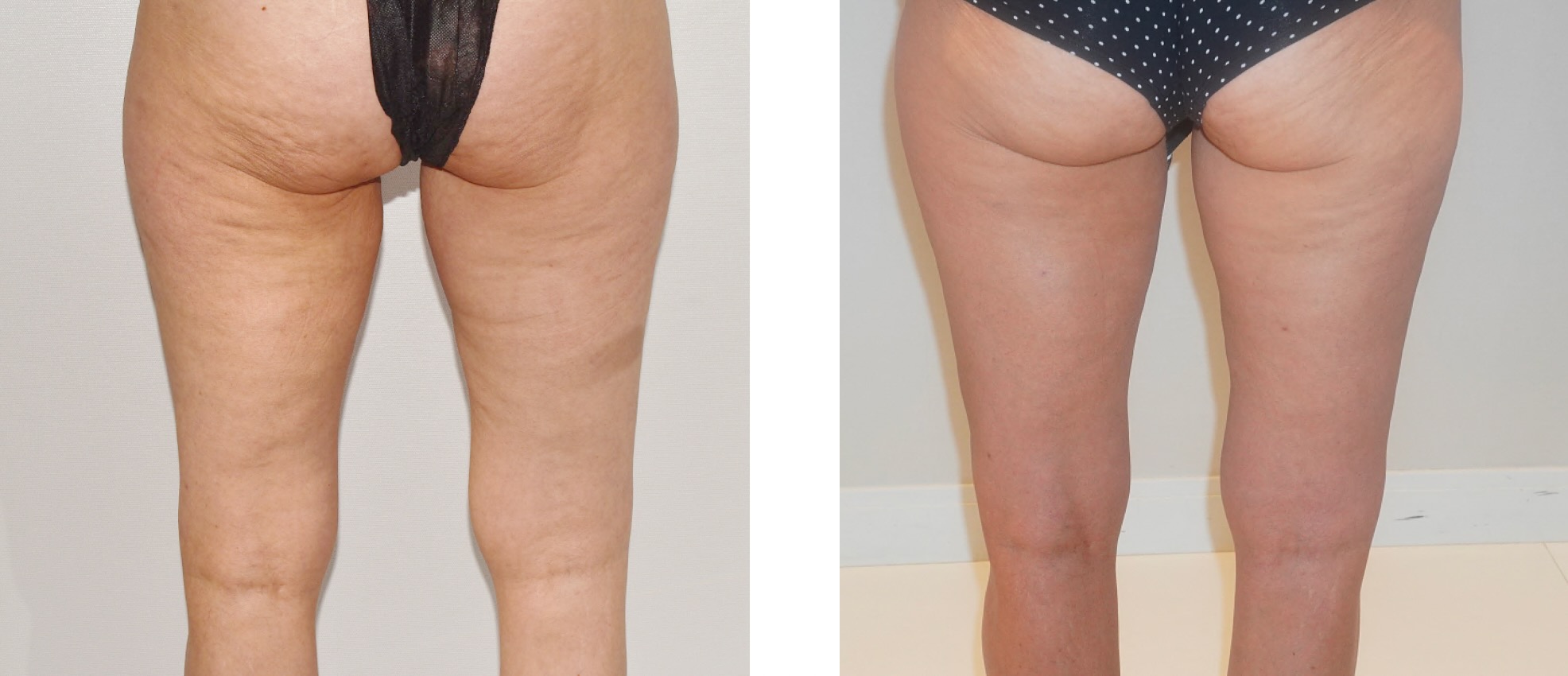
Discuss your goals and the treatment options for your anatomy with Dr. Darren M. Smith at a consultation in New York City.
The inner thigh, and the limit that governs it.
The inner thigh is the most commonly requested thigh area and the one where doing too much does the most harm. Patients arrive with one of two goals: relief from chub rub, the heat rash that develops when the thighs hit each other during activity in humid weather, or the thigh gap. Reducing the volume of the medial thigh lowers the chance the two thighs touch while walking, which addresses both at once.
The diagnostic question that comes first
Before technique, Dr. Smith asks what is causing the fullness: extra fat, loose skin, or both. For most patients wanting trimmer inner thighs the answer is extra fat, and focused liposuction treats it well. For a smaller group the answer is skin, and liposuction is the wrong tool.
The technique
Inner thigh liposuction on its own is performed under local anesthesia in the office, with the patient in and out the same day, often within a couple of hours. An oral medication beforehand is available for patients who want to feel more relaxed. A plan that treats several walls of the thigh at one sitting is a larger operation and is performed under general anesthesia or intravenous sedation, depending on the case, with a board-certified anesthesiologist.
A tiny incision of about two to three millimeters is placed in each groin crease. Tumescent numbing solution is instilled through them and left to take effect for about 10 to 15 minutes, then a long thin instrument called a cannula suctions the fat out carefully. The procedure takes about half an hour to 45 minutes in most cases, and each incision is closed with a single stitch. Dr. Smith calls the approach here focused micro liposuction: small volumes, precisely placed, rather than aggressive debulking.
The limit, stated plainly
If fat is removed from an inner thigh that already has significant skin laxity, the inner thigh can look worse than it did before. The inner thigh is a particularly sensitive area when it comes to extra skin. Take the fat out from under loose skin and that skin hangs, and it looks unflattering. This is the one place where more fat removed is reliably not better.
Skin quality therefore caps the volume of fat that can be removed, and the loose skin has to be assessed as carefully as the fat. A patient with excellent elasticity can have a great deal removed safely; a patient with poor elasticity cannot. Where laxity is mild to moderate, radiofrequency tightening can be added at the same sitting. Where it is severe, liposuction is not the right operation.
Outer thigh, anterior thigh, and the banana roll.
Outer thigh and saddlebags
The outer thigh is extremely amenable to treatment with liposuction. The deposits there are often called saddlebags, because the outward bulge seen from the side resembles the bags attached to a saddle. The goal here is debulking the leg as a whole, which is why it is frequently treated alongside the inner thigh.
Anterior thigh
The front of the thigh is the least commonly treated of the four walls. The candidate is specific: someone who, viewed from the side, has a bulge of fat giving the front of the thigh a convex contour so it projects further than the rest of the leg. Patients without that profile get little from treating this wall.
The banana roll, and the attachment that has to be preserved
The banana roll is the fullness beneath each buttock, named for the shape it takes viewed from behind. Treating it can make the buttocks pop and reduces the bulk of the upper leg.
This area requires particular technical care, because the fatty bulk should be reduced aggressively while the connective tissue attachments between the buttock and the banana roll are left intact. Damage those attachments and the definition of the crease under the buttock is lost, which looks unnatural.
When radiofrequency is added, and what it achieves.
Radiofrequency skin tightening is added when a patient has mild to moderate loose skin over the treated area. Dr. Smith uses the BodyTite device for this, at the same time as the liposuction. It is the reason a patient with some laxity can still be a liposuction candidate.
BodyTite is a bipolar radiofrequency device. One pole passes under the skin and one stays on top of it, and energy is fired between the two to heat the skin in a controlled way to the temperatures at which contraction is induced, while stimulating collagen and elastin. The effect is to shrink wrap the skin onto the new contour. A heat sensor sits on both poles, so temperature is regulated at both points. No new incision is needed: the probe goes through the incisions already made for the liposuction. It lengthens the procedure but does not otherwise make recovery worse, and it does not change the compression schedule.
What it does not achieve
It does not remove skin, and it is not a substitute for an operation that does. For severe laxity it is not a good approach, and a patient whose laxity is too extreme for the device will not get a satisfying result. Dr. Smith is direct that these devices deliver a fraction of what excision delivers, with the thigh lift as the benchmark, and that good comparative data on how much tightening each technology achieves does not exist.
At-home tightening devices and topical creams do not solve this problem either. Dr. Smith compares throwing collagen and elastin at skin that is losing its elasticity to throwing wood at a collapsing wooden house.
Two things govern the result: the operator's skill, because holding both poles at precise temperatures is finicky, and patient selection, which is the laxity question above. The result is not immediate, with a small improvement early and continued contraction over the following months.
BodyTite is the only energy-based tightening device Dr. Smith uses on the thigh itself, and helium plasma tightening is not offered here. For loose skin around the knees the tool is AccuTite, a much smaller version of the same technology.
When liposuction is not the answer.
Severe loose skin: the medial thigh lift
For severe loose skin the only procedure that works is excisional, and Dr. Smith's framing of it is deliberately discouraging. A medial thigh lift is something a patient really does not want to get involved with unless the loose skin problem is severe. It is essentially a massive weight loss operation, for people whose skin could not contract back and has to be cut out.
The scar runs from the inner thigh down toward the knee in many cases, and the recovery is longer and more difficult than anything else on this page. For the right patient that trade is worth making, because the improvement is substantial and nothing less invasive produces it. For a patient with only mild to moderate laxity it is not, and Dr. Smith steers that group firmly toward the radiofrequency route.
A medial thigh lift is performed under general anesthesia or intravenous sedation, depending on the case. Sutures are usually internal and are not removed, and no drains are used. Patients working remotely are generally back at it at one week and back in an office at two weeks. The thighs stay swollen to larger than their pre-operative size for one to two weeks. Upper body activity is light at two weeks; lower body and core activity is light for four weeks; and there are no restrictions at six weeks. Compression is worn for four weeks. There is significant improvement by one month and most of the result is present at three months.
Who thigh liposuction suits.
The best candidate has localized fat on one or more walls of the thigh and skin elastic enough to contract onto the smaller shape. Dr. Smith's analogy is a balloon: let a little air out and the shell gets smaller without much change in how it sits, but let most of it out and the shell looks deflated and hangs.
It suits a patient at a stable weight treating a shape problem rather than a weight problem: thighs that touch during activity, a saddlebag bulge on the outer thigh, a convex front thigh contour in profile, or a crease under the buttock obscured by the banana roll. Mild to moderate laxity is workable only when radiofrequency tightening is added at the same sitting. Severe laxity is not, because fat removal alone makes the inner thigh look worse and device tightening will not help enough either. How skin responds can be predicted to a reasonable degree at examination, and age, smoking and genetics all affect it.
What the practice requires before surgery
- No nicotine in any form for four weeks before surgery and four weeks after it. That includes cigarettes, vaping, pouches, patches and gum. The practice tests for nicotine. It matters more here than almost anywhere, because the result depends on skin that has to contract and heal.
- Review all medicines and supplements at consultation, including prescriptions and over-the-counter products. The practice’s 10-day preoperative pause for substances that act as blood thinners applies only when the surgical team and, for prescribed medicines, the prescribing clinician agree it is appropriate. Do not stop a prescribed medicine on your own.
- Medical clearance and laboratory work for any case done under anesthesia, and laboratory work for cases done under local anesthesia. Patients over 40 having anesthesia also have an EKG.
- Weight stable for three months before the operation, since thigh contour moves with weight.
Recovery after thigh liposuction.
The compression garment
A compression garment is worn for four weeks after thigh liposuction. That applies to every wall of the thigh, whether one is treated or all four, and it does not change when radiofrequency tightening is added: sustained compression is what lets the skin heal down onto the deeper tissue below, which is the point of adding the radiofrequency step in the first place. Written instructions cover when the garment comes off to shower and how it is washed.
Swelling and the result
Expect swelling for a week or two before any real result starts to show, and about three months before the final result is reasonably clear. Where radiofrequency tightening was added, the skin continues to contract over the months after that, so the tightening is the slower component to arrive.
Follow-up visits, and who provides post-operative care
Patients are seen the next morning, then at one week, two weeks, one month, three months, six months and one year. That schedule is the minimum, and patients may come in as often as they want on top of it.
Dr. Smith leads all post-operative care himself. He and the practice's physician assistant see post-operative patients together, and he is present for every major visit; some minor visits may be with the physician assistant alone. The arrangement gives patients continuity from the surgeon who performed the operation, with enough capacity in the schedule that a patient who wants to be seen is seen, rather than being rationed to a fixed number of appointments.
Risks.
Liposuction and radiofrequency tightening are safe when performed the right way by an experienced provider, and both carry risks that should be discussed specifically before a patient decides.
For radiofrequency tightening Dr. Smith names infection, bleeding problems, and damage to nerves in the treated area. He is candid that the technique is demanding and that the result depends on the operator's expertise as much as on patient selection.
Liposuction carries the risks common to surgical procedures: bleeding, infection, changes in skin sensation, fluid collection, contour irregularity, asymmetry, anesthesia risk and the possibility of a revision procedure. Two thigh-specific outcomes are failures of judgment or technique rather than complications: loose hanging skin on the inner thigh after fat is removed from a patient who had too much laxity, and loss of the crease under the buttock when the banana roll attachments are damaged.
Procedures are performed in Dr. Smith's accredited outpatient surgical facility inside his Manhattan office at 111 East 57th Street, with board-certified anesthesiologists only. The facility is accredited by QUAD A. Dr. Smith is board-certified by the American Board of Plastic Surgery. Power-assisted liposuction is among the techniques performed in the practice; which instrumentation suits a given case is decided at consultation.
What drives the cost of thigh liposuction.
The number of walls treated is the largest driver. The inner thigh alone costs less than the inner and outer thighs together, and a circumferential plan across all four walls costs more again, because each area adds operative time.
Whether radiofrequency tightening is added is the second driver, since it lengthens the procedure and brings device costs. Anesthesia is the third: an inner thigh case done under local anesthesia in the office costs less than a case requiring an anesthesiologist and a longer facility booking. Beyond those, cost reflects the surgeon's qualifications and experience and the facility. The more invasive a procedure is the more it costs, which is why an excisional thigh lift sits well above any liposuction plan.
The quote, the deposit and the revision policy
Every quote is itemized into a surgeon's fee, a facility fee and an anesthesia fee, so that each component is visible rather than bundled into one number. All post-operative visits are included in the quote. Other items are not. A quote is valid for 30 days, and a 10 percent deposit is taken at booking.
For one year after surgery there is no surgeon's fee on a revision. The patient remains responsible for the anesthesia and facility fees if a revision is performed.
Consultations are $500, applied toward any procedure booked, and the fee is not waived. The practice offers financing through CareCredit and Alphaeon Credit. Dr. Smith is out of network with all insurance plans; the practice helps patients use out-of-network benefits toward care.
Your questions about thigh liposuction.
Can liposuction make my inner thighs look worse?
Yes, if you have significant skin laxity there. The inner thigh is particularly sensitive when it comes to extra skin. Remove fat from under skin that is already loose and that skin can hang and look unflattering, which is worse than what you started with. This is why the loose skin is assessed as carefully as the fat, and why skin quality caps how much fat can come out.
Do I need to be asleep for inner thigh liposuction?
No, not when the inner thigh is treated on its own. It is performed under local anesthesia in the office, and you are in and out the same day, often within a couple of hours. An oral medication beforehand is available if you would like to feel more relaxed, and the procedure takes about half an hour to 45 minutes in most cases. A plan covering several walls of the thigh at one sitting is different: that is done under general anesthesia or intravenous sedation, depending on the case, with a board-certified anesthesiologist.
Where are the incisions for inner thigh liposuction?
One tiny incision of about two to three millimeters in each groin crease. The numbing solution goes in through them and the cannula follows through the same openings. Each is closed with a single stitch. If radiofrequency tightening is added, the probe goes through those same incisions.
How long do I wear the compression garment?
Four weeks, after any thigh liposuction. It is the same whether one wall of the thigh is treated or all four, and it does not change if radiofrequency tightening is added, because the sustained compression is what lets the skin heal down onto the deeper tissue below. Written instructions cover when it comes off to shower and how it is washed.
When will I see the result?
Expect a week or two of swelling before any real result shows, and about three months before you have a good idea of the final result. If radiofrequency tightening was added, the skin continues to contract over the following months, so the tightening is the slower component to arrive.
Will liposuction give me a thigh gap?
It can, when the fullness is caused by fat. Reducing the volume of the inner thigh lowers the chance the two thighs touch when you walk, which produces both the gap and relief from chub rub. Whether it works for you depends on what is causing the fullness, the first question asked at consultation.
Do I need a thigh lift instead?
Only if your loose skin problem is severe. Dr. Smith's position is that a medial thigh lift is not something to get involved with otherwise. It is essentially a massive weight loss operation, for patients left with skin that cannot contract back. The scar runs from the inner thigh down toward the knee in many cases and the recovery is longer and more difficult. For mild to moderate laxity he steers patients to radiofrequency tightening instead. If you do have one, it is performed under general anesthesia or intravenous sedation, sutures are internal and are not removed, no drains are used, compression is worn for four weeks, and there are no restrictions by six weeks.
What is the banana roll, and is treating it risky?
The banana roll is the fullness just beneath each buttock, named for its shape seen from behind. Reducing it can make the buttocks pop and reduce the bulk of the upper leg. The technical risk is specific: the connective tissue attachments between the buttock and the banana roll must be preserved. Damage them and the definition of the crease under the buttock is lost, which looks unnatural.
Can radiofrequency tightening replace a thigh lift?
No. It delivers a fraction of what an excisional operation delivers, and the thigh lift is the benchmark. For mild to moderate laxity it works well and is added at the same sitting through the same incisions. For severe laxity it is not a good approach, and a patient whose laxity is too extreme for the device will not get a satisfying result.
Can the outer thighs and saddlebags be treated at the same time?
Yes. The outer thigh is extremely amenable to liposuction and is commonly treated alongside the inner thigh, because the goal there is debulking the leg as a whole. Dr. Smith assesses the thigh as a 360 degree structure, so which walls are treated together follows from the overall shape you are after.
Is the front of my thigh treatable?
Sometimes, though it is the least commonly treated wall. The candidate has, seen from the side, a bulge of fat making the front of the thigh convex so it projects further than the rest of the leg. If that describes you, anterior thigh liposuction works well. If it does not, treating this wall adds little.
What about the loose skin around my knees?
That is treated with AccuTite rather than BodyTite. AccuTite is the same bipolar radiofrequency technology in a much smaller hand piece, which is what allows it to be used in small and delicate areas. It goes in through a needle puncture rather than a true incision, and those punctures heal without a visible scar.