
Reverse Tummy Tuck in New York City
When is a reverse tummy tuck the right procedure?
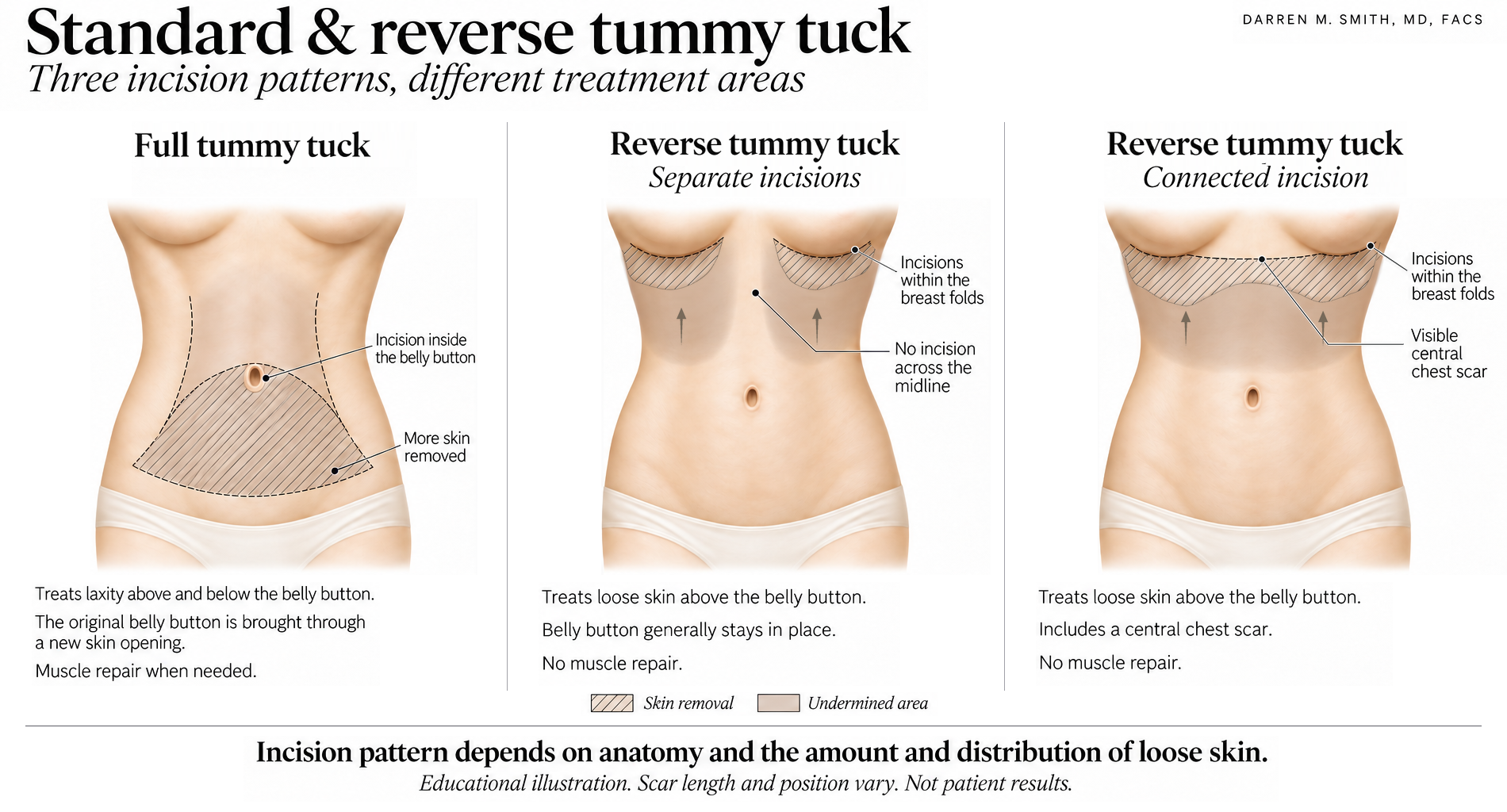
A reverse tummy tuck removes loose skin above the belly button through incisions in the folds beneath the breasts. It can address selected upper-abdominal laxity when the lower abdomen does not need a standard tummy tuck. Dr. Smith does not perform muscle repair with a reverse tummy tuck.
Dr. Smith evaluates the skin above and below your belly button, your abdominal wall and any previous surgery before recommending an approach. For patients who have already had a tummy tuck, a reverse procedure may be an option when upper-abdominal laxity remains but there is not enough residual laxity for a secondary standard abdominoplasty.
Your consultation compares a reverse tummy tuck with a full tummy tuck and mini and hybrid approaches, including the differences in scar placement and recovery. The aim is to choose the operation that fits your anatomy and the change you want.
PATIENT EXPERIENCE
A patient’s perspective.
Hear one patient’s tummy tuck experience with Dr. Smith.
Your consultation is a chance to discuss your goals and the approach that fits your anatomy.
Plan your consultationWhat is a reverse tummy tuck?
A reverse tummy tuck, which surgeons also call a reverse abdominoplasty, removes loose skin from the upper abdomen and pulls the remaining skin upward instead of downward. In a standard tummy tuck the incision sits low, at the bikini line, and the skin of the abdomen is drawn down toward it. In a reverse tummy tuck the incision is placed in the fold underneath the breasts, the inframammary fold, and the upper abdominal skin is lifted up toward that fold and secured to the deeper tissues of the chest wall so it holds its position. Dr. Smith does not perform muscle repair with a reverse tummy tuck.
The easiest way to think about it is that a standard tummy tuck takes up slack from below and a reverse tummy tuck takes up slack from above. That one difference explains essentially everything about who it suits, where the scar ends up, and why most patients with loose abdominal skin are still better served by one of the other tummy tuck options.
How does a reverse tummy tuck compare with other tummy tucks?
Choosing a reverse tummy tuck starts with deciding how best to address loose skin above the belly button. Dr. Smith compares four approaches based on the location and extent of skin laxity, the abdominal wall and your goals.
| Feature | Reverse tummy tuck | Hybrid abdominoplasty | Mini tummy tuck | Full tummy tuck |
|---|---|---|---|---|
| Where the incision sits | In the fold beneath the breasts | Low, inside the bikini line | Low, inside the bikini line | Low, inside the bikini line, plus around the belly button |
| Skin it treats | Above the belly button | Below the belly button, with BodyTite tightening above it | Below the belly button only | Above and below the belly button |
| Muscle repair | Not performed | Case by case | Can extend above the navel if the separation is not too wide | Full length, almost always in postpartum patients |
| Best suited to | Upper laxity only; prior tummy tuck with insufficient laxity for a secondary standard abdominoplasty; or a breast procedure through the same fold | Mild upper laxity with excess skin below the navel | Excess skin limited to the lower abdomen | Laxity throughout the abdomen, most mommy makeover patients |
One alternative to consider is the hybrid abdominoplasty, a term Dr. Smith coined for combining a mini tummy tuck skin excision below the belly button with BodyTite, a radiofrequency device, to tighten mild laxity in the upper abdomen. For a patient whose upper abdominal skin is only mildly loose, the hybrid approach often gets there with the scar kept low and hidden, and without a scar in the breast fold. When the upper abdominal laxity is more than mild, BodyTite is not going to be enough, and that is where a full tummy tuck or, in the right patient, a reverse tummy tuck comes back into the conversation.
Who is a good candidate for a reverse tummy tuck?
Dr. Smith assesses three factors before recommending a reverse tummy tuck: the location of loose skin, the amount of excess skin and your comfort with the planned scar.
The first question is where the loose skin actually is. A reverse tummy tuck is designed for laxity that sits above the belly button, and it does very little for the lower abdomen. If there is loose skin or a pouch below the navel too, which is the case for most women after pregnancy, a full tummy tuck addresses both areas from a single low incision and is almost always the better choice.
The second question is how much skin there is to remove. Because the skin is being lifted toward the breast fold, there is a limit to how much can be taken out before the fold itself starts to get pulled down or distorted. That makes the reverse tummy tuck a good fit for a moderate amount of upper abdominal laxity, and a poor fit for a large apron of skin, where a full or extended tummy tuck is really the right operation.
The third question is how you feel about a scar in the breast fold. For many patients, that location is an acceptable trade-off. Dr. Smith discusses whether the scar pattern and expected improvement fit your goals.
Who benefits most?
In Dr. Smith's practice the reverse tummy tuck makes the most sense in a few specific situations. One is the patient who has already had a tummy tuck, here or elsewhere, and is left with residual loose skin in the upper abdomen but does not have enough residual laxity to perform a secondary standard abdominoplasty. Another is the patient who is having a breast lift, breast reduction or breast augmentation through an inframammary incision anyway, because the upper abdominal skin can be addressed through the same incision, so the reverse tummy tuck adds very little in the way of new scarring. A third is the patient after significant weight loss, including weight loss on a GLP-1 medication such as Ozempic, Wegovy, Mounjaro or Zepbound, whose loose skin is concentrated in the upper abdomen and whose lower abdomen has held up well, which is less common than people expect but does happen.
Dr. Smith requires a stable weight for at least 3 months before surgery and no nicotine in any form for 4 weeks before and 4 weeks after surgery. The practice tests for nicotine. These requirements support safety and healing.
Where is the reverse tummy tuck scar?
The scar sits in the inframammary fold, the crease beneath each breast, where in most women it is hidden by the natural shadow of the breast and by a bra or bikini top. Depending on how much skin needs to come out, the incisions under each breast can stay separate or can be connected across the midline of the chest. A connected incision gives more access and allows more skin to be removed, and the trade-off is a segment of scar in the center of the chest that can show in lower-cut tops, so Dr. Smith discusses and agrees on the incision plan with you before surgery.
The main technical concern is keeping that scar where it belongs. The upper abdominal skin naturally wants to pull downward, so the lifted skin has to be anchored firmly to the deeper tissue of the chest wall, which keeps the scar in the fold and keeps the breast fold from being dragged down over time.
What is the surgery and recovery like?
The surgery is done under general anesthesia with a board-certified physician anesthesiologist, in Dr. Smith's QUAD A-accredited surgical facility on the ground floor of the Ritz Tower at 111 East 57th Street, so the consultation, the operation and the follow-up all happen at the same address. An overnight stay is not required after a reverse tummy tuck.
After surgery, patients wear a compression garment for 4 weeks. The upper abdomen may feel tight for the first couple of weeks; this is expected and settles as the tissues relax. Most people return to desk work in about 1 week, light lower-body exercise at around 2 weeks, and full upper-body, lower-body and core activity at around 4 weeks, with Dr. Smith's clearance. Follow-up visits with Dr. Smith take place the morning after surgery, then at 1 week, 2 weeks, 1 month, 3 months, 6 months and 1 year. Patients can be seen more often whenever they need and have 24/7 access to Dr. Smith and his team throughout recovery. Patients coming from out of town should plan on staying in New York for about a week.
How much does a reverse tummy tuck cost?
The cost depends on whether the reverse tummy tuck is done on its own or alongside a breast procedure, how much skin needs to be removed, and the facility and anesthesia time that follows from those decisions. Every quote from Dr. Smith's office is itemized into the surgeon's fee, the facility fee and the anesthesia fee, and it includes all of your post-operative visits, so you know exactly what you are paying for. The practice offers patient financing through CareCredit and Alphaeon.
Your reverse tummy tuck consultation
A reverse tummy tuck tightens loose skin above the belly button through an incision hidden in the breast fold, it leaves the belly button where it is, and it works best for moderate upper abdominal laxity, for residual upper abdominal laxity after a previous tummy tuck when there is not enough laxity for a secondary standard abdominoplasty, and for patients having a breast procedure through the same fold. If your loose skin extends below the belly button, or if it is only mild, a full tummy tuck or a hybrid abdominoplasty is usually the better path. Dr. Smith will help you compare these options during consultation.
In-person consultations at the Ritz Tower, 111 East 57th Street, or start with a video consultation if you are traveling from out of town. Call 212-633-0627.
Schedule a consultationFrequently asked questions
Do reverse tummy tucks work?
Yes, for the right patient. A reverse tummy tuck reliably tightens moderate loose skin above the belly button, including after a prior tummy tuck when there is not enough residual laxity for a secondary standard abdominoplasty, or alongside a breast procedure. It does not treat the lower abdomen, so patients with laxity both above and below the navel usually do better with a full tummy tuck.
Do you get a new belly button with a reverse tummy tuck?
Usually not. Because the skin is lifted upward toward the breast fold, the belly button generally stays in place and is not repositioned, so there is no scar around it.
Where is the scar after a reverse tummy tuck?
In the fold beneath the breasts, where a bra or bikini top usually covers it. If the incisions are connected across the midline for more skin removal, part of the scar sits in the center of the chest.
Who is a good candidate for a reverse tummy tuck?
Someone at a stable weight with moderate loose skin concentrated above the belly button, a lower abdomen in good shape, and no nicotine use. It suits patients with residual upper laxity after a previous tummy tuck who do not have enough residual laxity for a secondary standard abdominoplasty, and those having a breast lift, reduction or augmentation through the breast fold.
Can you combine a reverse tummy tuck with a breast lift?
Yes, and it is one of the best reasons to choose it. Both procedures can use the same incision in the breast fold, so the upper abdomen is tightened with very little added scarring.
How much does a reverse tummy tuck cost in NYC?
It depends on whether it is combined with a breast procedure and how much skin needs to be removed. Dr. Smith's quotes are itemized into surgeon, facility and anesthesia fees and include all post-operative visits; financing is available through CareCredit and Alphaeon.
What is the difference between a reverse tummy tuck and a regular tummy tuck?
A regular tummy tuck uses a low bikini-line incision and pulls skin downward, treating the whole abdomen. A reverse tummy tuck uses an incision in the breast fold and pulls skin upward, treating only the area above the belly button.